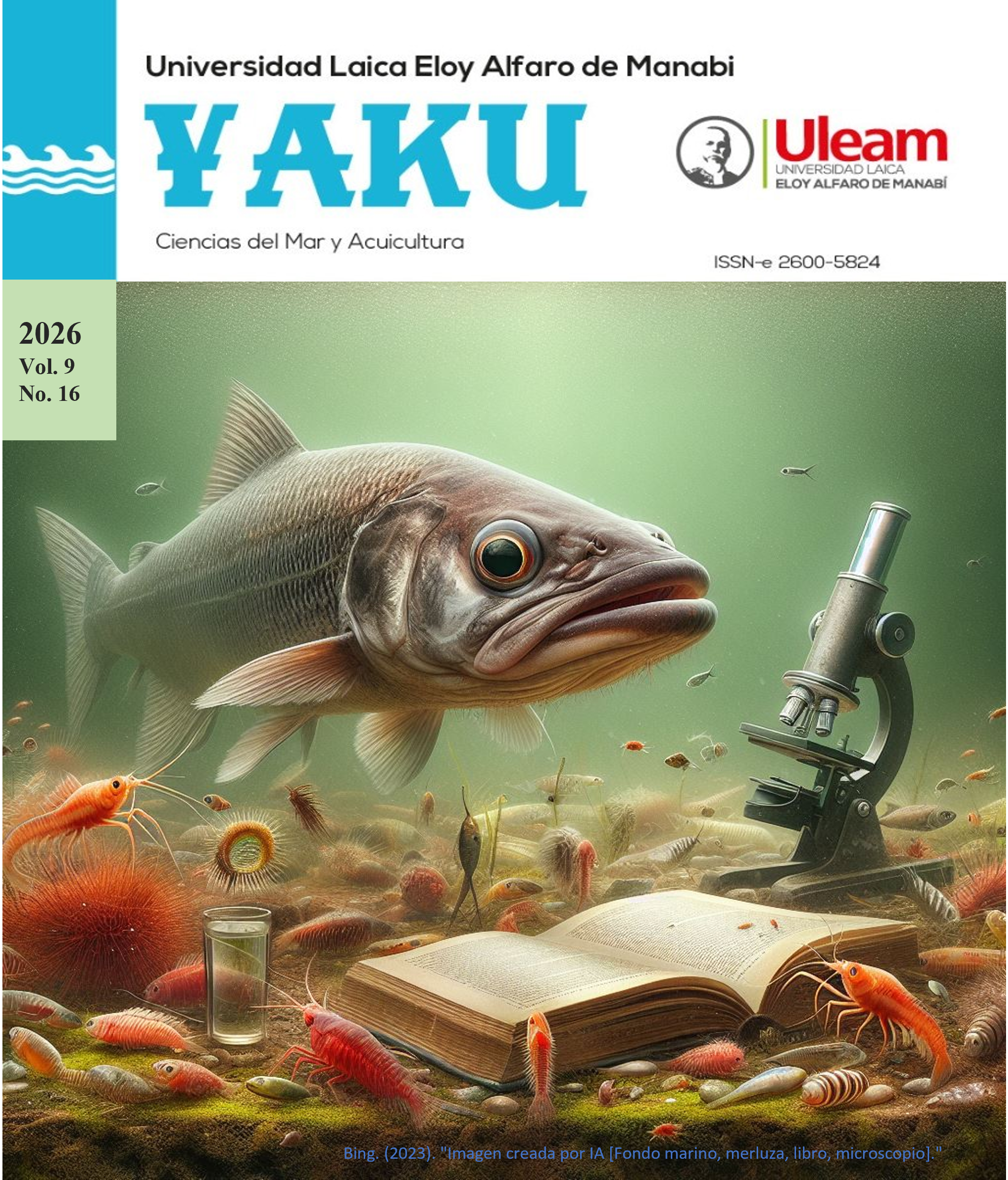
Evaluation of trace metals in (Ichthyoelephas humeralis) and socio-environmental perception of river pollution in Babahoyo Canton, Ecuador
DOI:
https://doi.org/10.56124/yaku.v9i16.004Keywords:
Ecotoxicology, cadmium, mercury, bioaccumulationAbstract
The concentrations of cadmium (Cd) and mercury (Hg) were evaluated in the muscle tissue of the endemic detritivorous fish Ichthyoelephas humeralis from the river system of Babahoyo canton, Ecuador, along with the socio-environmental perception of artisanal fishers regarding water pollution. Thirty specimens were analyzed using atomic absorption spectrophotometry, and structured surveys were administered to artisanal fishers. Morphometric variables showed a significant positive correlation between length and weight (rho = 0.994; p < 0.001). In all individuals, Cd and Hg concentrations remained below the analytical limits of quantification (<0.014 mg/kg for Cd and <0.09 mg/kg for Hg) and the maximum limits established by international regulations. Most fishers perceived a high degree of pollution in the river system and expressed concern over the quality of hydrobiological resources and food security, although they demonstrated limited knowledge about pollution sources and low participation in mitigation actions. It is concluded that these results establish an ecotoxicological baseline for I. humeralis and provide insight into the socio-environmental perception of fishing communities, which is useful for future monitoring programs and the sustainable management of hydrobiological resources.
Downloads
References
Aguirre, W. E., Alvarez-Mieles, G., Anaguano-Yancha, F., Burgos Morán, R., Cucalón, R. V., Escobar-Camacho, D., Jácome-Negrete, I., Jiménez Prado, P., Laaz, E., Miranda-Troya, K., Navarrete-Amaya, R., Nugra Salazar, F., Revelo, W., Rivadeneira, J. F., Valdiviezo Rivera, J., & Zárate Hugo, E. (2021). Conservation threats and future prospects for the freshwater fishes of Ecuador: A hotspot of Neotropical fish diversity. Journal of Fish Biology, 99(4), 1159-1190. https://doi.org/10.1111/jfb.14844
Balali-Mood, M., Naseri, K., Tahergorabi, Z., Khazdair, M. R. y Sadeghi, M. (2021). Toxic Mechanisms of Five Heavy Metals: Mercury, Lead, Chromium, Cadmium, and Arsenic. Frontiers in Pharmacology, 12, Artículo 643972. https://doi.org/10.3389/fphar.2021.643972
Codex Alimentarius Commission. (1995). General standard for contaminants and toxins in food and feed (CXS 193-1995). FAO/WHO. https://www.fao.org/fao-who-codexalimentarius
Doadrio Villarejo, A. L. (2004). Ecotoxicología del mercurio y sus compuestos. Anales de la Real Academia Nacional de Farmacia, 70(4), 855–885.
Enríquez, M., & Quinchiguango, R. (2025). Contenido de metales pesados en peces y mariscos consumidos en el Ecuador: Una revisión sistemática. Revista Científica Dékamu Agropec, 6(1), 67–79. https://doi.org/10.55996/dekamuagropec.v6i1.293
European Commission. (2006). Commission Regulation (EC) No 1881/2006 setting maximum levels for certain contaminants in foodstuffs. Official Journal of the European Union. https://eur-lex.europa.eu/legal-content/EN/TXT/?uri=CELEX:32006R1881
European Commission. (2008). Commission Regulation (EC) No 629/2008 amending Regulation (EC) No 1881/2006. Official Journal of the European Union. https://eur-lex.europa.eu
Echevarría Díaz, G. E., Sánchez Orellana, F. R., Yunda Vega, R. E., Valdiviezo-Rivera, J. S., & Ríos-Touma, B. P. (2025). Trace metal contamination in commercial fish from the Ecuadorian Amazon: Preliminary health risk assessment in a local market. Fishes, 10(8), Artículo 392. https://doi.org/10.3390/fishes10080392
Food and Agriculture Organization of the United Nations, & World Health Organization. (2011). Report of the joint FAO/WHO expert consultation on the risks and benefits of fish consumption (FAO Fisheries and Aquaculture Report No. 978). FAO. https://www.fao.org/4/ba0136e/ba0136e00.pdf
Froese, R. (2006). Cube law, condition factor and weight–length relationships: history, meta-analysis and recommendations. Journal of Applied Ichthyology, 22(4), 241-253. https://doi.org/10.1111/j.1439-0426.2006.00805.x
Islam, M. S., Ahmed, M. K., Raknuzzaman, M., Habibullah-Al-Mamun, M. y Islam, M. K. (2015). Heavy metal pollution in surface water and sediments: A preliminary assessment of an urban river in a developing country. Ecological Indicators, 48, 282–291. https://doi.org/10.1016/j.ecolind.2014.08.016
Loor-Bravo, G. A., Pico-Lozano, E. X., Sánchez-Moreira, J. D., & Mendoza-Nieto, K. X. (2020). Evaluación de la presencia de mercurio (Hg) en pez espada, Xiphias gladius (Linnaeus, 1758) desembarcado en el puerto de Manta, Ecuador. Dominio de las Ciencias, 6(3), 1256–1270. https://dominiodelasciencias.com/ojs/index.php/es/article/view/1367
Mancera-Rodríguez, N. J. y Álvarez-León, R. (2006). Estado actual del conocimiento de las concentraciones de mercurio y otros metales pesados en aguas, sedimentos y organismos acuáticos en Colombia. Acta Biológica Colombiana, 11(1), 3–23. https://www.redalyc.org/pdf/3190/319028578001.pdf
O'Dell, B. (1983). Bioavailability of essential and toxic trace elements: Introduction. Federation Proceedings, 42(6), 1713–1714.
Ochoa-Ubilla, B. Y., Mendoza-Nieto, K. X., Vivas-Moreira, R., Urdánigo-Zambrano, J. U., & Ferrer-Sánchez, Y. (2016). Estructura de tallas de captura y relación longitud-peso de peces nativos en el humedal Abras de Mantequilla, Ecuador. Revista Ciencia y Tecnología, 9(2), 19–27. https://doi.org/10.18779/cyt.v9i2.191
Ochoa-Ubilla, Y., Urdánigo-Zambrano, J. P., & Mendoza-Nieto, K. (2025). Impactos socioecológicos de las artes de pesca tradicionales en la provincia de Los Ríos (Ecuador): Conflictos entre prácticas ancestrales y sostenibilidad. Revista de Ciencias del Mar y Acuicultura YAKU, 8(14), 003. https://doi.org/10.56124/yaku.v8i14.003
Organización Mundial de la Salud. (2012). Comisión del Codex Alimentarius: Programa conjunto FAO/OMS sobre normas alimentarias. OMS.
Prado España, M., & Muñíz Vidarte, L. (2012). Relaciones tróficas en el sistema hídrico de la provincia de Los Ríos: Ichthyoelephas humeralis y Brycon alburnus. Revista Científica Ciencias Naturales y Ambientales, 6(1). https://doi.org/10.53591/cna.v6i1.198
Ramírez, A. V. (2008). Intoxicación ocupacional por mercurio. Anales de la Facultad de Medicina, 69(1), 46–51. https://doi.org/10.15381/anales.v69i1.1184
Repetto Jiménez, M. (1995). Toxicología avanzada. Editorial Díaz de Santos. https://dialnet.unirioja.es/servlet/libro?codigo=311761
Revelo, W. (2010). Aspectos biológicos y pesqueros de los principales peces del sistema hídrico de la provincia de Los Ríos, durante 2009. Boletín Científico y Técnico, 20(6), 53–84. Instituto Nacional de Pesca.
Revelo, W., & Laaz Moncayo, E. D. (2012). Catálogo de peces de aguas continentales de la provincia de Los Ríos, Ecuador. Boletín Especial del Instituto Nacional de Pesca, 3(5). https://www.researchgate.net/publication/304012205
van der Oost, R., Beyer, J., & Vermeulen, N. P. E. (2003). Fish bioaccumulation and biomarkers in environmental risk assessment: A review. Environmental Toxicology and Pharmacology, 13(2), 57–149. https://doi.org/10.1016/S1382-6689(02)00126-6
Villarreal de la Torre, D., Sánchez, J., & Cañarte, J. (2016). Comparación y valoración de mercurio (Hg) y cadmio (Cd) en la especie Dorado (Coryphaena hippurus) que se consume en Manta, Ecuador. La Técnica: Revista de las Agrociencias, (16), 32–45. https://doi.org/10.33936/la_tecnica.v0i16.533
Vörösmarty, C. J., McIntyre, P. B., Gessner, M. O., Dudgeon, D., Prusevich, A., Green, P., ... y Davies, P. M. (2010). Global threats to human water security and river biodiversity. Nature, 467(7315), 555–561. https://doi.org/10.1038/nature09440
Published
How to Cite
Issue
Section
License
Copyright (c) 2026 Revista de Ciencias del Mar y Acuicultura YAKU. ISSN: 2600-5824.

This work is licensed under a Creative Commons Attribution-NonCommercial-ShareAlike 4.0 International License.

1.jpg)