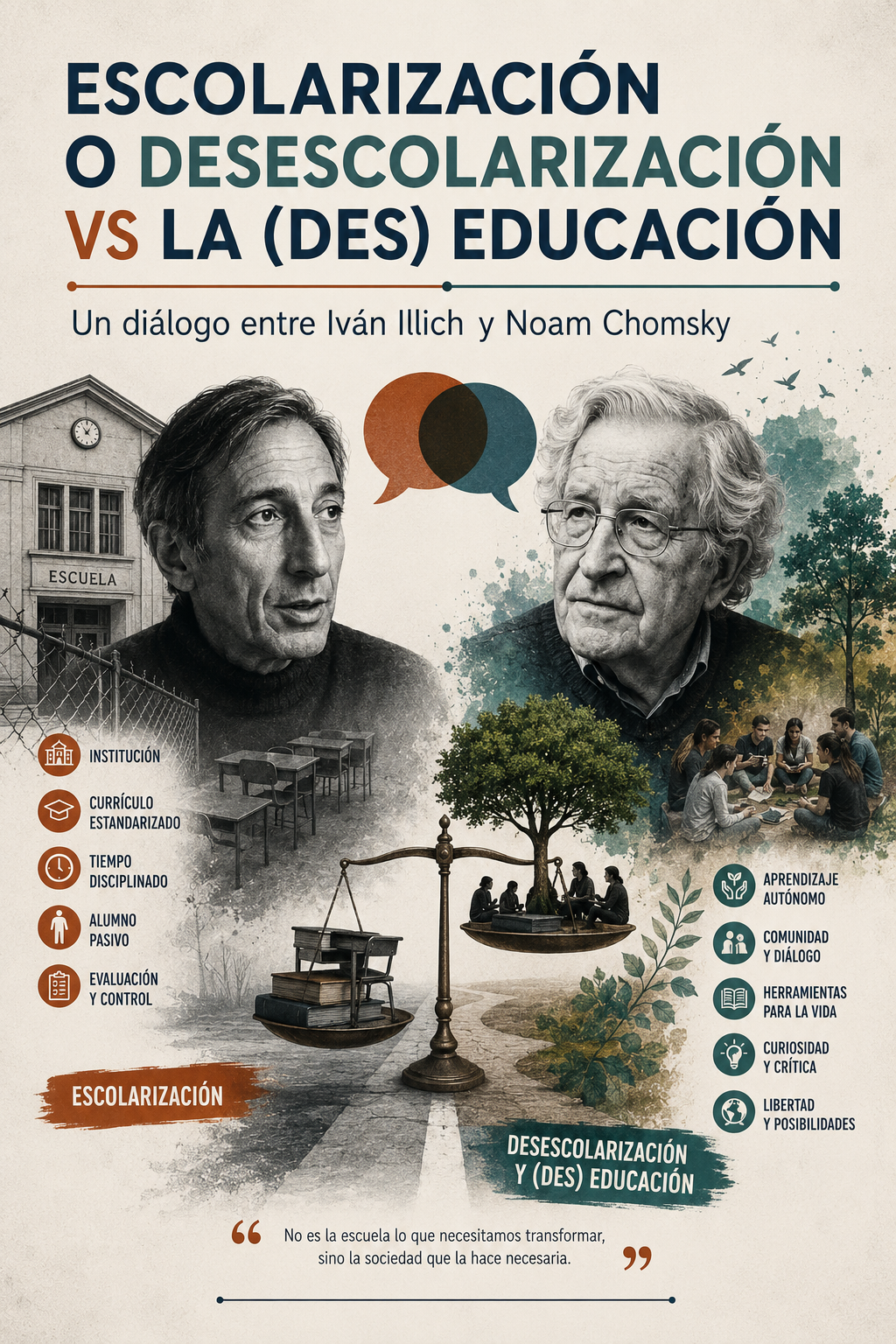
Schooling or Deschooling vs. (Dis)education. A dialogue between Ivan Illich and Noam Chomsky
DOI:
https://doi.org/10.56124/claustro.v6i11.007Keywords:
critical thinking, democracy, autonomyAbstract
Teaching and learning are understood, according to the conceptions of Ivan Illich and Noam Chomsky, as processes that occur not only in the conventional educational context. This research aimed, firstly, to analyze the theoretical frameworks of both authors regarding the understanding of schooling, deschooling, and (dis)education; and, secondly, to establish a dialogue between the resulting contributions, with the intention of offering possible alternatives that improve the experience of interacting meaningfully with reality and knowledge. The results agree that schools must review their current role in an attempt to redirect their approach towards more relevant goals, such as promoting free, critical, and reflective thinking, which, along with redefining personal, cognitive, and intellectual autonomy, fosters the construction of a consistent position, open to reasoning and argumentation. Furthermore, there is the possibility of overcoming monolithic ways of thinking that seek to reproduce assertions with little relevance to the demands of a changing and dynamic world. In conclusion, moving towards relevant teaching and learning practices implies eradicating the indoctrination and domestication that permeate the content, resources, and experiences provided by educational institutions. Meeting this challenge requires developing a critical consciousness capable of understanding, adopting, and embracing experiences in which students not only overcome ideological manipulation but also cultivate the skills associated with exploring and discovering truth.
Downloads
References
Angulo, J., Soler, C y Redon, S. (2024). Chomsky, democracia y educación. Discusiones filosóficas, 24 (43), 199-121. https://doi.org/10.17151/difil.202324.43.9.
Bermejo, J. (2021). El método dialógico-crítico en educomunicación para fomentar el pensamiento narrativo. Comunicar, 68(29), 111-121. https://doi.org/10.3916/C67-2021-09
Berrío, M., Chávez, D, Cangalaya, L y Arias, D. (2024). Pensamiento crítico y comprensión lectora en un texto de Edgar Morin. ACADEMO (Asunción), 11(1):29-37. https://doi.org/10.30545/academo.2024.ene-abr.4
Cabrera, D. (2022). Leer el mundo, experiencia y praxis. Logos, 50 (38), 75-92. DOI: https://doi.org/10.26457/lrf.v138i138.3171
Castells, N. García-Milà, M., Miralda, A., Luna, J., y Pérez, E. (2022), El razonamiento de los adolescentes para gestionar las noticias falsas. Educación XX1: Revista de la Facultad de Educación, 25(2), 291-313. https://doi.org/10.5944/educxx1.31693
Cassany, D. (2021). Lectura crítica en tiempos de desinformación. Revista Electrónica Leer, Escribir y Descubrir, 1(9). Disponible en https://digitalcommons.fiu.edu/led/vol1/iss9/3
Corre, C. (2024). De la formación teórica al pensamiento epistémico en los posgrados en Educación en América Latina. Revista UNIMAR, 42(1), 87-102. https://doi.org/10.31948/ru.v42i1.3850
Curiel, R., Marenco, E y Alvarado, M. (2021). Filosofia para niños y niñas: una herramienta para fortalecer la lectura en el aula y el pensamiento crítico. Revista de Filosofía, Número Especial, 21-31. https://doi.org/10.5281/zenodo.5140617
Chomsky, N. (1969). La responsabilidad de los intelectuales. Editorial Galerna.
Chomsky, N. (1971). Lenguaje y entendimiento. Seix Barral
Chomsky, N. (2006). Sobre democracia y educación. Paidós
Chomsky, N. (2014). La (Des) Educación. Austral.
Fonseca, C., Quinto, S y Urrea, G. (2023). Las posibilidades para propiciar el pensamiento epistémico desde el paradigma socio-crítico en el investigador doctoral. Revista Dialogus. Núm. 11, pp. 155-163. http://portal.amelica.org/ameli/journal/326/3264631009/
Freire, P. (2002a). Pedagogía del oprimido. Siglo XXI Editores.
Freire, P. (2002b). Educación y cambio. Disponible http://derechoepja.org/wp-content/uploads/2015/05/freire-paulo_educacicion-y-cambio.pdf [Consulta, 2026, Junio 10]
Freire, P y Faundez, A. (2013). Por una pedagogía de la pregunta: crítica a una educación basada en respuestas a preguntas inexistentes. Siglo XXI Editores.
Freire, P. y Shor, I (2014). Miedo y Osadía. La cotidianidad del docente que se arriesga a practicar una pedagogía transformadora. Siglo XXI.
Gajardo, M. (1993). Iván Ilich. Revisa de Educación Comparada, 23, (4), 757-767. https://dialnet.unirioja.es/servlet/articulo?codigo=3097650
Harada, E. (2012). La filosofía de Matthew Lipman y la educación. Perspectivas desde México. Universidad Autónoma de México.
Herrero, E., y La-Rosa, L. (2022). Los estudiantes de secundaria y la alfabetización mediática en la era de la desinformación. Comunicar: Revista Científica de Comunicación y Educación, 30(73), 95-106. https://doi.org/10.3916/C73-2022-08
Illich, I. (1985). La sociedad desescolarizada. Ediciones Godot.
Lipman, M. (1998). Pensamiento y educación. Ediciones La Torre.
Lipman, M. (2016). Escribir: cómo y porque. Ediciones de la Torre.
Molina, J. (2021). Los principales rasgos de la pedagogía socrática. Stylos, 30 (30), 36-43. https://doi.org/10.46553/sty.30.30.2021.p36-43
Morales, J. (2023). Lectura e investigación en Matthew Lipman. Prácticas al servicio del aprendizaje en la educación del siglo XXI. Yachay Revista Científico Cultural, 12 (1), 58-64. https://revistas.uandina.edu.pe/index.php/Yachay/article/view/672/291
Morales, J. (2024). Los procesos de enseñanza y aprendizaje en tiempos de complejidad. Sugerencias desde la perspectiva de Matthew Lipman. Revista Investigación y Postgrado, 39 (1), 9-27. https://doi.org/10.56219/investigacinypostgrado.v39i1.2697
Morales, J. (2025). Lectura académica, investigación científica y modos de pensamiento ¿cómo producir conocimiento en la educación universitaria. Revista de Ciencia y Tecnología El Higo, 15 (1), 215-235. https://doi.org/10.5377/elhigo.v15i1.20608
Morín, E. (2009). Introducción al pensamiento complejo. Editorial Gedisa.
Oliveros, S., Valenzuela, C y Núñez, C. (2023). Los siete saberes necesarios para la educación del futuro”, de Edgar Morín: Una mirada desde la alfabetización en información. Revista Andina de Educación, 6 (2), 1-11. https://doi.org/10.32719/26312816.2022.6.2.8
Olvera, M. y Márquez, J. (1977). Antología Iván Illich. Disponible https://www.ivanillich.org.mx/Illich-Antologia.pdf
Ruiz, L. (2024). Edgar Morín y los siete saberes necesarios a la educación del futuro. Revista Holón, 2 (5), 3-15. https://revistas.up.ac.pa/index.php/holon
Zemelman, H. (2015). Pensamiento y construcción de conocimiento histórico una exigencia para el hacer futuro. Revista El Agora USB, 15(2), 343-362. https://nbn-resolving.org/urn:nbn:de:0168-ssoar-462691
Zemelman, H. (2021). Pensar Teórico y Pensar Epistémico: los retos de las Ciencias Sociales latinoamericanas. Espacio Abierto. 30, (3), 234-244. https://produccioncientificaluz.org/index.php/espacio
Published
How to Cite
Issue
Section
License
Copyright (c) 2026 Revista Científica Arbitrada de Posgrado y Cooperación Internacional CLAUSTRO - ISSN: 2737-6478.

This work is licensed under a Creative Commons Attribution-NonCommercial-ShareAlike 4.0 International License.





4.jpg)