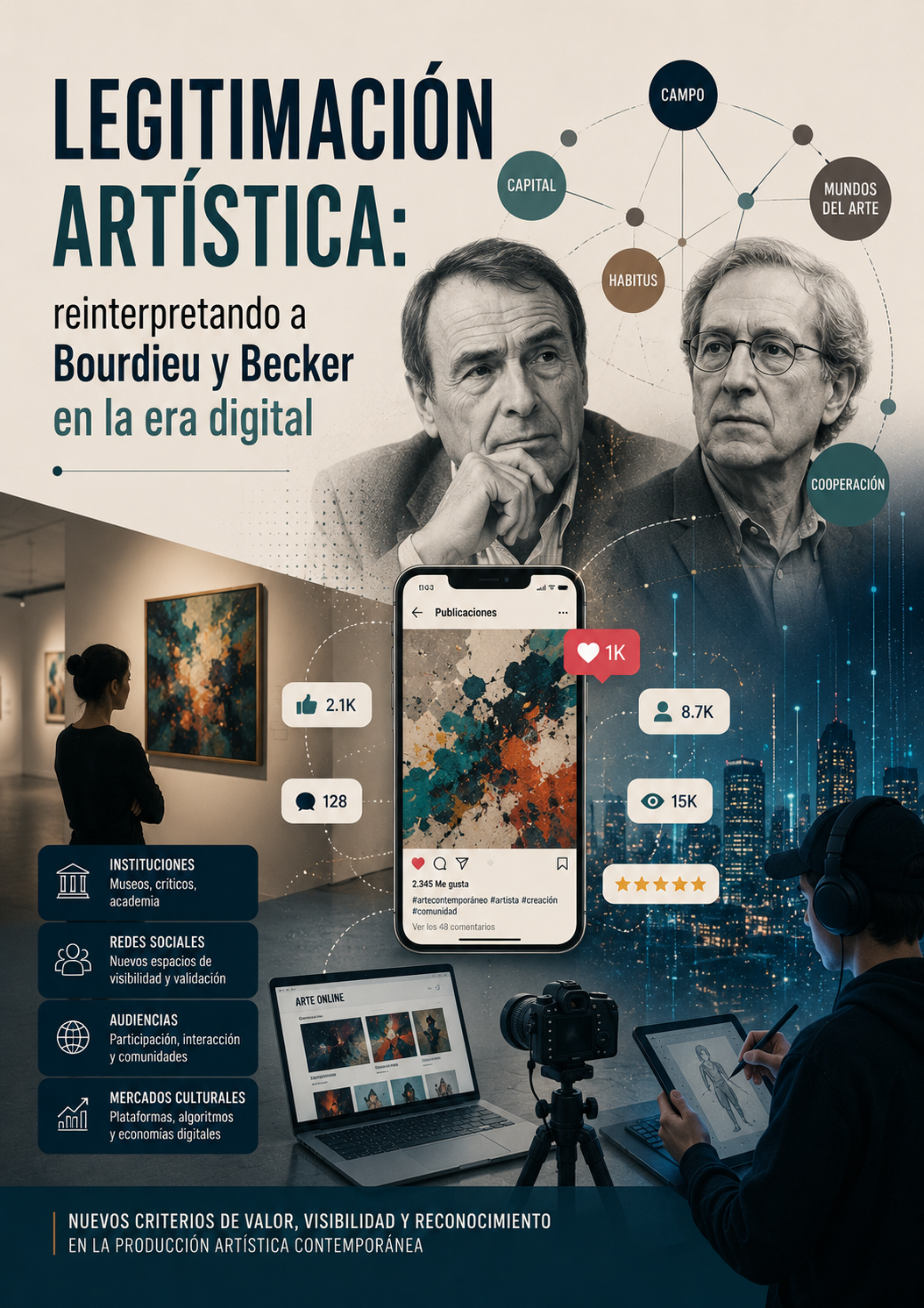
Artistic legitimization: reinterpreting Bourdieu and Becker in the digital age
DOI:
https://doi.org/10.56124/claustro.v6i11.012Keywords:
sociology of art, algorithms, artistic legitimization, digital cultureAbstract
The study aimed to analyze students' perceptions of the algorithmic dynamics embedded in digital platforms within the processes of artistic legitimization, based on a reinterpretation of the theories of Pierre Bourdieu and Howard Becker. The research was based on the premise that algorithms do not replace traditional institutions; rather, they operate as emerging mechanisms of cultural mediation that reshape patterns of visibility, recognition, and symbolic value within the artistic field. An exploratory quantitative approach was adopted. Data were collected through a survey administered to 30 students enrolled in the Performing Arts program at Universidad Laica Eloy Alfaro de Manabí. The findings indicate that 87% of participants perceive social media as a decisive factor in enhancing artists' visibility. Digital collaboration, the influence of content creators, and the size of an artist's online audience were identified as key elements associated with artistic success. At the same time, respondents acknowledged the continuing importance of traditional forms of recognition, including academic training, professional experience, and institutional endorsement. The findings suggest that artistic legitimization has evolved into a hybrid process in which digital popularity and engagement metrics coexist with established systems of cultural validation. While algorithms increasingly shape public attention by determining the visibility of artistic content, traditional cultural institutions continue to play a fundamental role in the construction of artistic prestige and long-term professional recognition.
Downloads
References
Adler, J. (2024). Desvíos de la inteligencia artificial en las artes tecnológicas: Algoritmos, cuerpos, afectos y otras materialidades hacia el desmantelamiento del mito de la novedad. Eikón / Imago, 13(1).
Alexander, V. D., & Bowler, A. E. (2021). Contestation in aesthetic fields: Legitimation and legitimacy struggles in outsider art. Poetics, 84, Article 101485. https://doi.org/10.1016/j.poetic.2020.101485
Álvarez-Carrión, J. A., Moscoso-Parra, R. K., & Espinoza-Valdiviezo, E. N. (2025). Derechos de autor y obras generadas por inteligencia artificial: Desafíos legales y propuestas de adaptación normativa. Journal Scientific MQRInvestigar, 9(3), 1–19. https://doi.org/10.56048/MQR20225.9.3.2025.e883
Becker, H. S. (1982). Art worlds. University of California Press.
Bourdieu, P. (1993). The field of cultural production: Essays on art and literature. Columbia University Press.
Fernández Rodríguez, C. J., & Heikkilä, R. (2025). Algoritmos y jerarquización cultural: El impacto de la digitalización en la construcción del gusto. Revista Internacional de Sociología, 83(3). https://doi.org/10.3989/ris.2025.83.3.1363
Hernández Sampieri, R., & Mendoza Torres, C. P. (2023). Metodología de la investigación: Las rutas cuantitativa, cualitativa y mixta. McGraw-Hill Interamericana.
Kitchin, R. (2021). Data lives: How data are made and shape our world. Policy Press. https://doi.org/10.1332/policypress/9781529215144.001.0001
Lee, J. W., & Lee, S. H. (2023). The legitimation of young and emerging artists in digital platforms: The case of Saatchi Art. The Journal of Arts Management, Law, and Society, 53(1), 19–41. https://doi.org/10.1080/10632921.2022.2080136
Marín-Marín, A. E. (2026, 18 de abril). El algoritmo como dispositivo cultural. Anesma. https://www.anesma.com/el-algoritmo-como-dispositivo-cultural
Ospina Rave, B. E., Sandoval, J. D., Aristizábal Botero, C. A., & Ramírez Gómez, M. C. (2005). La escala de Likert en la valoración de los conocimientos y las actitudes de los profesionales de enfermería en el cuidado de la salud. Investigación y Educación en Enfermería, 23(1), 14–29. https://www.redalyc.org/articulo.oa?id=105215401002
Pino Quintana, E. Y., & Duré Ramos, J. A. (2025). Arquitectura tecnológica y desafíos legales del arte generado por inteligencia artificial: Análisis desde la ingeniería de sistemas. Ciencia Latina Revista Científica Multidisciplinar, 9(5), 11174–11184. https://doi.org/10.37811/cl_rcm.v9i5.20391
Puertollano Galán, V., & Castro-Díaz, M. (2025). La inteligencia artificial en la creación artística: Innovación, homogeneidad y desafíos de la originalidad. Vivat Academia, 158, 1–17. https://doi.org/10.15178/va.2025.158.e1608
Ramos-Zaga, F. A. (2026). Imaginarios sociotécnicos y razón tecnocrática en la legitimación discursiva de la inteligencia artificial. Revista Iberoamericana de Argumentación, 32, 115–136. https://doi.org/ 10.15366/ria2026.32.005
Thomas, Ş. V., Herman, L. M., & Moruzzi, C. (2024). A machine walks into an exhibit: A technical analysis of art curation. Arts, 13(5), Article 138. https://doi.org/10.3390/arts13050138
Published
How to Cite
Issue
Section
License
Copyright (c) 2026 Revista Científica Arbitrada de Posgrado y Cooperación Internacional CLAUSTRO - ISSN: 2737-6478.

This work is licensed under a Creative Commons Attribution-NonCommercial-ShareAlike 4.0 International License.





4.jpg)