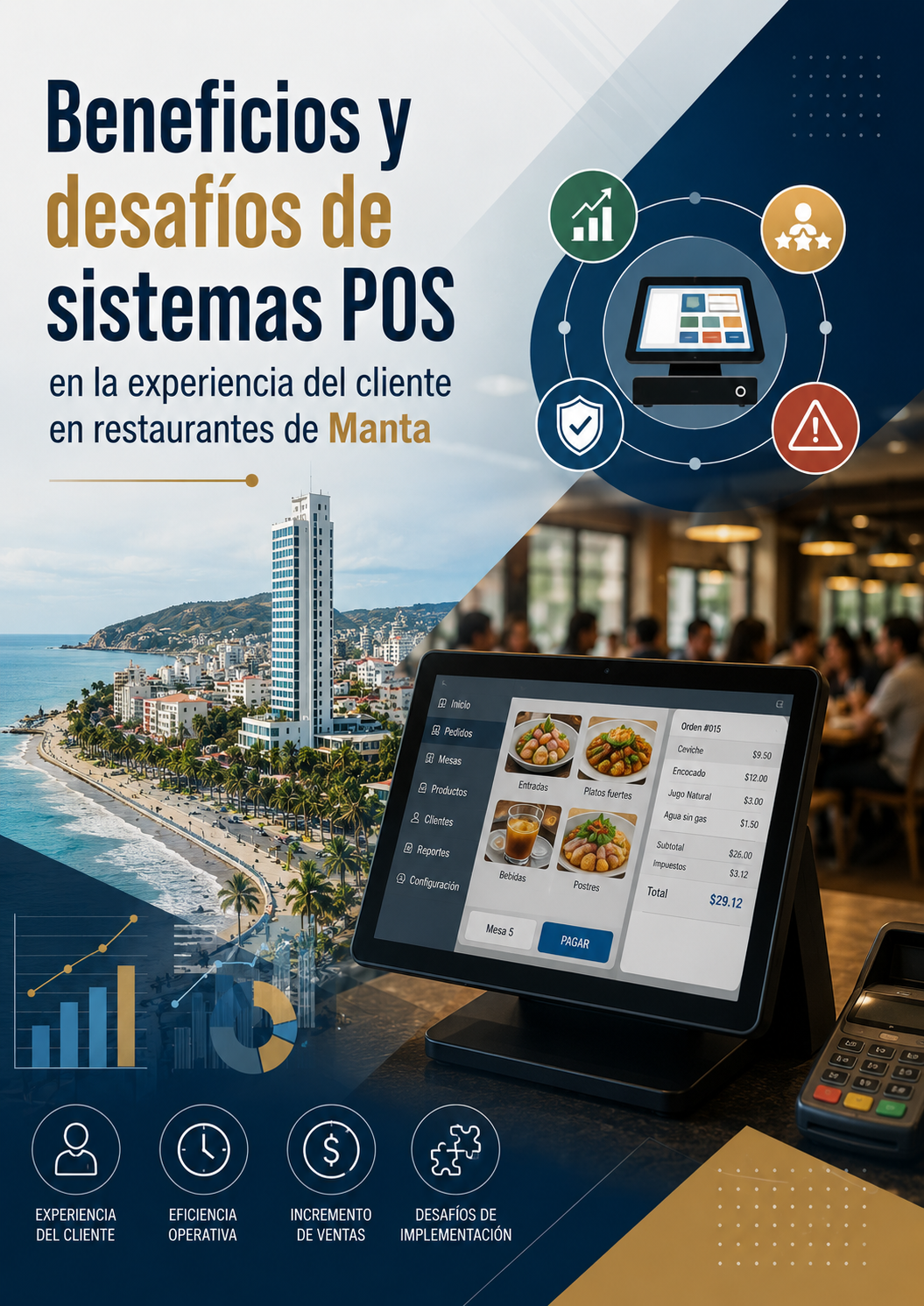
Benefits and Challenges of Point-of-Sale (POS) Systems in the Customer Experience at Restaurants in Manta
DOI:
https://doi.org/10.56124/claustro.v6i11.009Keywords:
Information technology, computer systems, administration, quality control, scientific innovationsAbstract
This study analyzed the benefits and challenges of point-of-sale (POS) systems for customer experience in restaurants in Manta. A mixed-methods, descriptive, non-experimental, cross-sectional approach was used. The quantitative component comprised five-point Likert-scale surveys administered to 70 customers; the qualitative component was based on eight interview records from informants involved in restaurant management and operations. Quantitative data were examined using frequencies and percentages, while the interviews underwent thematic analysis and were integrated through triangulation. Customers reported favorable evaluations of service speed and efficiency (80.0%), payment agility and accuracy (84.2%), correct order registration (84.2%), confidence during service (77.1%), and overall satisfaction (82.9%). Across the interviews, all eight cases recognized benefits related to control and organization and considered the investment favorable; all eight identified staff training or adaptation as a critical condition, seven reported technical or performance failures, four mentioned dependence on electricity or connectivity, and two identified limitations in technical support. Integration of the findings shows that customer-perceived benefits converge with informants’ operational assessments, while the latter reveal internal risks that are less visible to diners. POS systems can strengthen customer experience and restaurant management when adoption is supported by continuous training, technical assistance, and contingency protocols.
Downloads
References
Almeida Lino, E. V., & Carvajal Zambrano, G. V. (2023). La aplicación de Sistemas de Gestión de Calidad para negocios turísticos gastronómicos. Revista Internacional de Turismo, Empresa y Territorio, 7(1), 174–188. https://doi.org/10.21071/riturem.v7i1.15662
Andrade, C. (2021). The inconvenient truth about convenience and purposive samples. Indian Journal of Psychological Medicine, 43(1), 86–88. https://doi.org/10.1177/0253717620977000
Arias Gonzáles, J. L., & Covinos Gallardo, M. (2021). Diseño y metodología de la investigación. Enfoques Consulting EIRL. https://hdl.handle.net/20.500.12390/2260
Chancay, Merchán., M. Y. (2023). Aplicación móvil para la gestión de pedidos de comida en el restaurante “Yolita” de la parroquia Cascol [Trabajo de titulación, Universidad Estatal del Sur de Manabí]. Repositorio UNESUM. https://repositorio.unesum.edu.ec/bitstream/53000/5538/1/CHANCAY%20MERCH%C3%81N%20MADILETH%20YOLANDA.pdf
Chancusig, S. N., & Romero Balarezo, R. E. (2022). Implementación de sistema web y móvil para la gestión y automatización de pedidos en el restaurante “De Mar a Mar”. Trabajo de titulación, Universidad Agraria del Ecuador, Guayaquil, Ecuador. https://cia.uagraria.edu.ec/Archivos/ROMERO%20BALAREZO%20RAUL%20ESAU.pdf
Galarza-Sánchez, P. C., Agualongo-Yazuma, J. C., & Jumbo-Martínez, M. N. (2022). Innovación tecnológica en la industria de restaurantes del Cantón Pedro Vicente Maldonado. Journal of Economic and Social Science Research, 2(1), 31–43. https://doi.org/10.55813/gaea/jessr/v2/n1/45
García Marcillo, J. E. (2020). Aplicación móvil para la gestión de servicio del restaurante El Sabor de la Carreta K-DE en la ciudad de Jipijapa [Tesis de grado, Universidad Estatal del Sur de Manabí]. Repositorio Digital UNESUM. http://repositorio.unesum.edu.ec/handle/53000/2306
Gómez Arroyave, J., & Hernandez Jimenez, R. A. (2023). Sistema administrativo modular para restaurantes [Proyecto aplicado, Universidad Nacional Abierta y a Distancia]. Repositorio Institucional UNAD. https://repository.unad.edu.co/handle/10596/55926
Guevara, G. P., Verdesoto Arguello, A. E., & Castro Molina, N. E. (2020). Metodologías de investigación educativa (descriptivas, experimentales, participativas, y de investigación-acción) [Educational research methodologies (descriptive, experimental, participatory, and action research)]. RECIMUNDO, 4(3), 163–173. https://doi.org/10.26820/recimundo/4.(3).julio.2020.163-173
Heredia Reinoso, C. A. (2023). La influencia de la tecnología para incrementar la eficiencia y calidad del servicio en restaurantes (Trabajo de titulación, Universidad Tecnológica Indoamérica). https://dialnet.unirioja.es/institucion/upct/tesis?inicio=801
Hernández-Sampieri, R., & Mendoza, C. P. (2023). Metodología de la investigación: Las rutas cuantitativa, cualitativa y mixta (2.ª ed.). McGraw-Hill. https://www.mheducation.com/
Lu, S., & Ahn, J. (2023). An integrated model for understanding the role of self-service technology attributes and customers’ demographic characteristics in the restaurant service context. Journal of Foodservice Business Research, 28(5), 1063–1086. https://doi.org/10.1080/15378020.2023.2279002
Mayol Tur, M. (2023). ¿Incrementa el uso de las TIC la productividad y la satisfacción del personal y los huéspedes de los hoteles? Tesis doctoral, Universidad Politécnica de Cartagena.
Plaza Quimis, M., Sumba Nacipucha, N., Sastre Segovia, F. J., & Cueva Estrada, J. (2024). La economía digital en los restaurantes de Guayaquil: un estudio descriptivo. Journal of the Academy. https://doi.org/10.47058/joa11.8
Röding, T., Steinmann, S., Wagner, G., & Schramm-Klein, H. (2023). A classification of information-oriented PoS technology from customer perception. Journal of Retailing and Consumer Services, 70, Article 103126. https://doi.org/10.1016/j.jretconser.2022.103126
Şahin, E., & Yiğitoğlu, V. (2022). QR menü kullanımı kapsamında restoranlarda yenilikçi uygulamaların hizmet kalitesine ve restoran imajına etkisi [The effect of innovative applications in restaurants on service quality and restaurant image in the scope of using QR menus]. Journal of Tourism & Gastronomy Studies, 10(3), 1745-1768. https://doi.org/10.21325/jotags.2022.1065
Vizcaíno-Zúñiga, P. I., Cedeño-Cedeño, R. J., & Maldonado-Palacios, I. A. (2023). Metodología de la investigación científica: guía práctica. Ciencia Latina Revista Científica Multidisciplinar, 7(4), 9723-9762. https://doi.org/10.37811/cl_rcm.v7i4.7658
Vo-Thanh, T., Zaman, M., Hasan, R., Akter, S., & Dang-Van, T. (2022). The service digitalization in fine-dining restaurants: A cost-benefit perspective. International Journal of Contemporary Hospitality Management, 34(9), 3502-3524. https://doi.org/10.1108/IJCHM-09-2021-1130
Waqanimaravu, M., & Arasanmi, C. N. (2020). Employee training and service quality in the hospitality industry. Journal of Foodservice Business Research, 23(3), 216-227. https://doi.org/10.1080/15378020.2020.1724850
Vo-Thanh, T., Zaman, M., Hasan, R., Akter, S., & Dang-Van, T. (2022). The service digitalization in fine-dining restaurants: A cost-benefit perspective. International Journal of Contemporary Hospitality Management, 34(9), 3502-3524.
https://doi.org/10.1108/IJCHM-09-2021-1130
Waqanimaravu, M., & Arasanmi, C. N. (2020). Employee training and service quality in the hospitality industry. Journal of Foodservice Business Research, 23(3), 216-227. https://doi.org/10.1080/15378020.2020.1724850
Wong, I. A., Huang, J., & Lin, Z. (2024). Understanding smart service failure: The case of smart restaurants. International Journal of Hospitality Management, 119, Article 103714. https://doi.org/10.1016/j.ijhm.2024.103714
Published
How to Cite
Issue
Section
License
Copyright (c) 2026 Revista Científica Arbitrada de Posgrado y Cooperación Internacional CLAUSTRO - ISSN: 2737-6478.

This work is licensed under a Creative Commons Attribution-NonCommercial-ShareAlike 4.0 International License.





4.jpg)