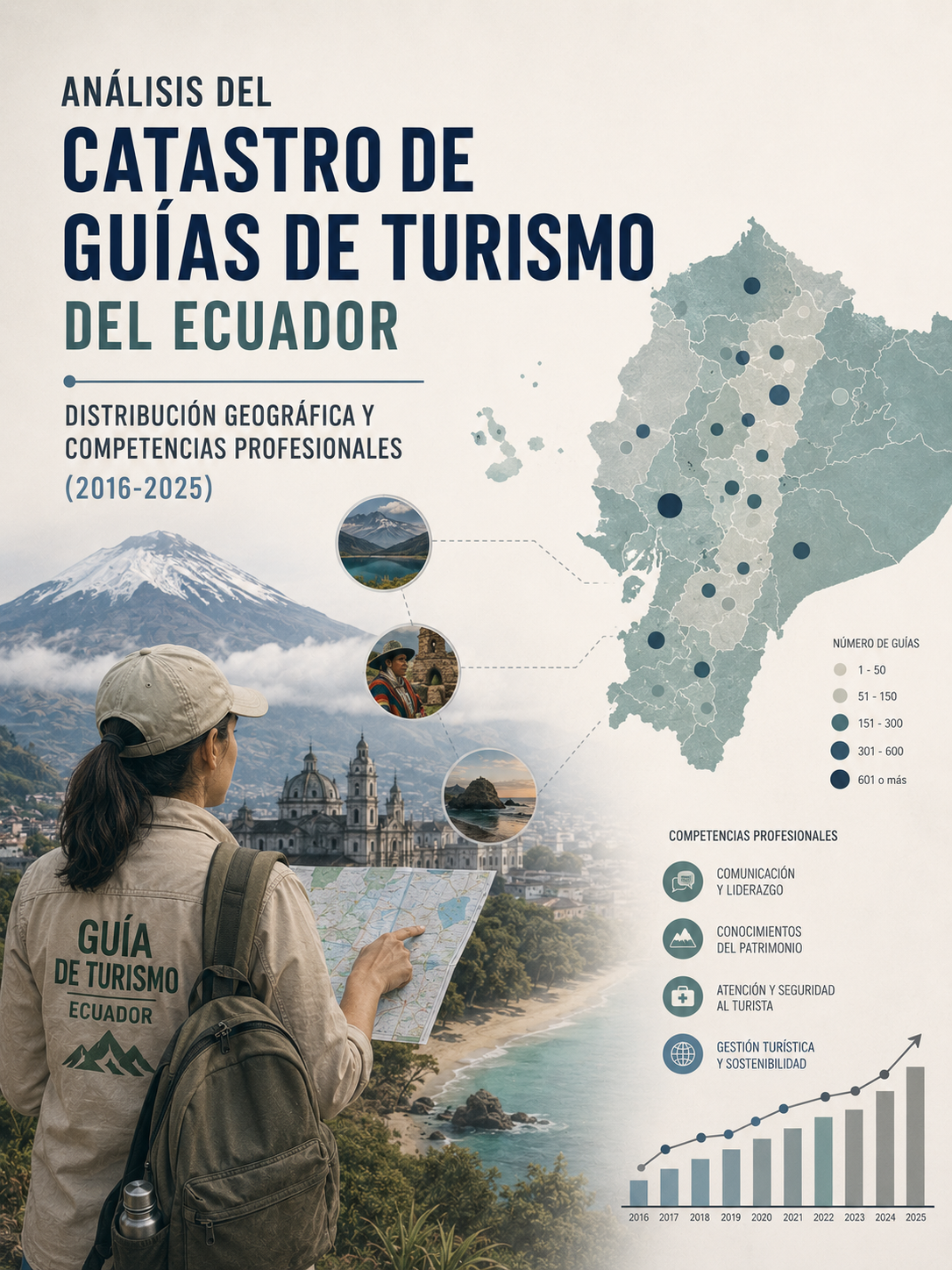
Analysis of the Tourism Guide Registry of Ecuador: Geographic Distribution and Professional Competencies (2016-2025)
DOI:
https://doi.org/10.56124/claustro.v6i11.004Keywords:
Turismo, capital humano, EcuadorAbstract
This article examines the National Tourism Guide Registry of the Republic of Ecuador as of October 2025, based on the analysis of 7,239 official records provided by the Ministry of Tourism. Quantitative methods including descriptive statistics, spatial distribution analysis, and time series were applied to characterize the human capital of Ecuador's tourism sector. Results reveal a marked geographic concentration: Pichincha accumulates 31.1% of guides, while Amazonian provinces represent only 13.1%. The predominant classification is Local Guide (42.8%), followed by National Tourism Guide (36.3%). 61.2% of guides declare English proficiency, although 24.4% have no registered linguistic information. It was identified that 22.4% of licenses are expired, an indicator requiring regulatory attention. Implications for strategic tourism planning and public policy formulation for professional certification and training are discussed.
Downloads
References
Ababneh, A. (2027) Guías turísticos e interpretación del patrimonio: la interpretación del pasado por parte de los guías en el sitio arqueológico de Jarash, Jordania. Revista de Turismo Patrimonial. https://doi.org/10.1080/1743873X.2017.1321003
Baum, T. (2007). Human resources in tourism: Still poor relation? Tourism Recreation Research, 32(1), 67-74. https://doi.org/10.1016/J.TOURMAN.2007.04.005
Banco Central del Ecuador. (2019). Cuentas satélites de turismo del Ecuador 2018. Banco Central del Ecuador. https://www.bce.ec/
Cohen, E. (1985). The tourist guide: The origins, structure and dynamics of a role. Annals of Tourism Research, 12(1), 5-29. https://doi.org/10.1016/0160-7383(85)90037-4
Durão, M., Veríssimo, M., Quintela, JA, & Marques, J. (2025). Capital humano en la industria turística y hotelera: Un enfoque bibliométrico. En Building Human Capital in Tourism and Hospitality (pp. 3–21). https://doi.org/10.1079/9781800624979.0001
González Rosales, VM, López Torres, VG, & Meraz Ruiz, L. (2019). Competitividad turística, análisis de validez y factorial de un instrumento, caso San Felipe, Baja California. Economía Sociedad y Territorio , 305–338. https://doi.org/10.22136/est20191344
Ibarra, O. A. M., Romo, E. A., & Merino, N. B. (2025). Evaluación del Desempeño de los Guías de Turistas en el Desarrollo de Rutas de Turismo Cultural en México. TURYDES Turismo Y Desarrollo Local Sostenible, 18(38), e1669. https://doi.org/10.55905/turydes.v18i38.1669
ILO. (2021). COVID-19 and the world of work: Impact on tourism. International Labour Organization.
Kemper, J., Young Lyn, A., McDonald, P, & Renold, U. (2025). Labor market outcomes of formal vocational education and training: a meta-analysis. Education Economics, 34 (2), 267-291 https://doi.org/10.3929/ethz-c-000788739
Márquez Scotti, C. (2024). Condiciones laborales en el sector turístico: una propuesta de operacionalización para América Latina. Economía Sociedad Y Territorio, 24(76), e2018. https://doi.org/10.22136/est20242018
Ministerio de Turismo de Costa Rica. (2020). Sistema de certificación de guías de turismo: Estándares y procedimientos. Instituto Costarricense de Turismo.
Ministerio de Turismo de Ecuador (2026). Catastro de guías de turismo de Ecuador
Pond, K. (1993). The professional guide: Dynamics of tour guiding. Van Nostrand Reinhold.
UNWTO. (2023). Tourism and culture synergies. World Tourism Organization. https://www.unwto.org/
Wan Shamsuddin, WIZ., Said, SY, & Harun, SN (2022). Interpretación de un sitio patrimonial: Satisfacción de los visitantes con las exposiciones interpretativas en Dataran Bandar. Planning Malaysia, 20 (22). https://doi.org/10.21837/pm.v20i22.1132
Weiler, B., y Ham, S. H. (2001). Tour guides and environmental interpretation. Encyclopedia of Ecotourism, 587-594. https://doi.org/10.1079/9780851993683.0549
WEF. (2024). Travel and Tourism Development Index 2024. World Economic Forum.
Published
How to Cite
Issue
Section
License
Copyright (c) 2026 Revista Científica Arbitrada de Posgrado y Cooperación Internacional CLAUSTRO - ISSN: 2737-6478.

This work is licensed under a Creative Commons Attribution-NonCommercial-ShareAlike 4.0 International License.




4.jpg)