The value and limitations of the generational construct in social science research
DOI:
https://doi.org/10.56124/claustro.v6i11.001Keywords:
generación, metodología de investigación, desarrollo humano, ética de la investigación, ciencias socialesAbstract
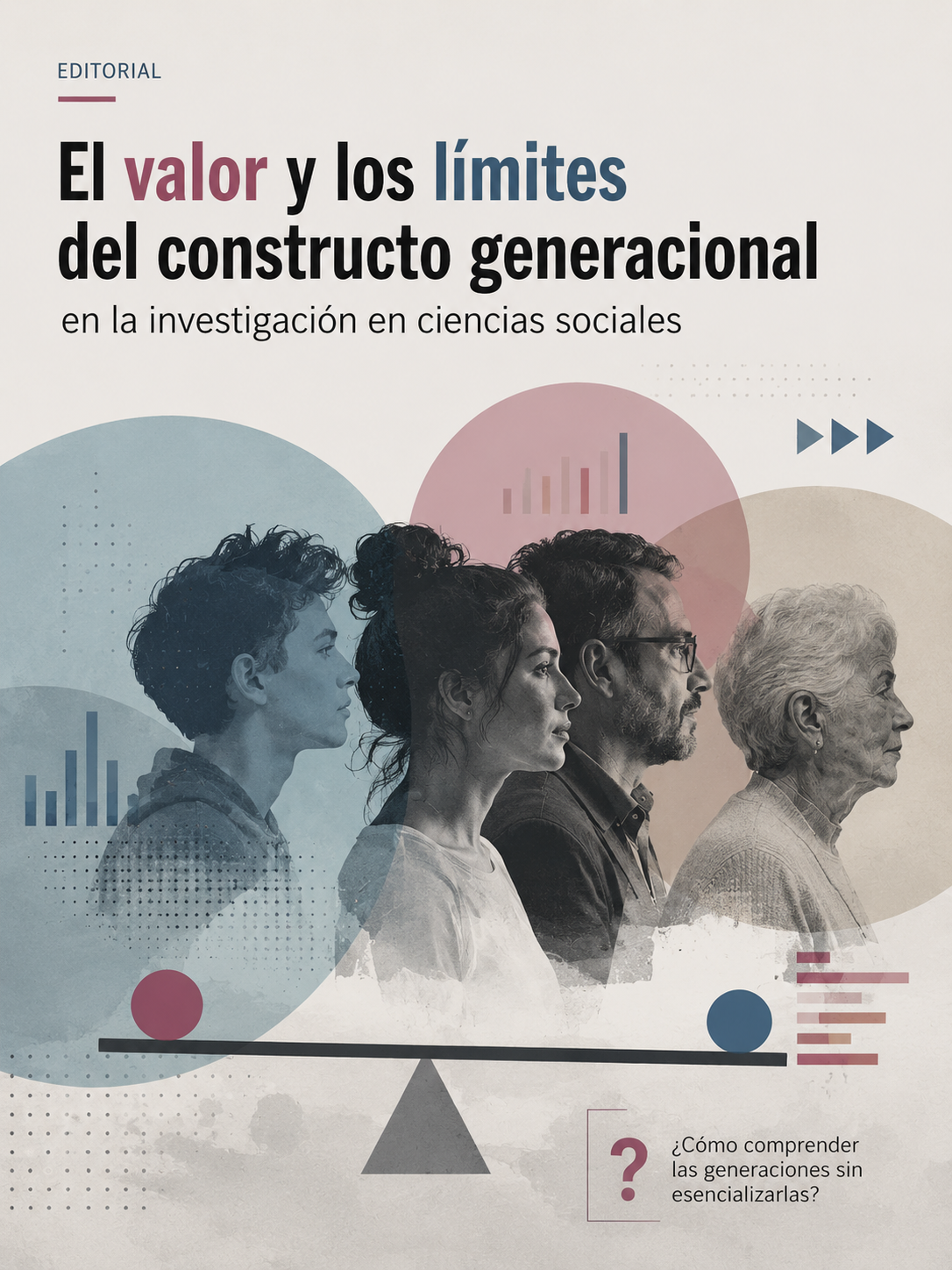
Few social science categories have achieved as much public prominence as that of the “generation.” We turn to it to bring order to the world, to explain why some people think, work, or consume in a certain way compared to others, and to narrate the passage of time through a collective lens. This wide circulation, however, is rarely accompanied by the caution that scientific work demands. At CLAUSTRO, we consider it timely to pause and examine the construct itself, asking what we gain and what we risk when we view human experience through it, because a good part of the quality of our research depends on this reflection.
The first risk is taking it literally. Grouping people by their year of birth rests on a flimsy premise: assuming that rather arbitrary temporal boundaries and having shared certain events are enough to uniformly describe an entire collective (Costanza et al., 2023). Doing so obscures factors that carry equal or greater weight than one's birth date—such as social position, gender, and economic conditions—all of which are decisive in the formation of intellectual and emotional capacities (Sternberg, 2012). Much of what is claimed about each group amounts to little more than a socially accepted prejudice, a phenomenon that literature terms generationalism and which is rarely backed by evidence (Costanza et al., 2023). Confusing the label with the problem it aims to describe is, precisely, the error that a scientific community should avoid above all others.
Recognizing these limitations does not mean discarding the construct entirely, as it still bears fruit when properly applied. Above all, it helps make sense of things; it allows us to interpret complex behaviors by linking them to age, and it functions as an image that reflects how each society organizes its relationship with time (Costanza et al., 2023; Leccardi & Feixa, 2011). Looking at and comparing groups through this lens holds significant exploratory value because it opens up new questions that can later be tested using various methods. Added to this are the insights from life-span theory, according to which human development progresses in multiple directions, allows for plasticity, and is historically situated (Baltes, 1987). The era in which one happens to live leaves a mark, but that mark intertwines with group-specific influences and unique individual events, meaning that life trajectories are always diverse.
From this emerges the idea we wish to put forward. The value of the construct does not lie in predicting identical profiles, but rather in bringing to the fore the weight of historical context as one more variable among those that shape human development. When forced to predict, however, it becomes a bias that denies the enormous internal variability of any collective and, against all logic, curtails our own capacity to understand and generalize. Conceived with prudence, it does not lock anyone into a rigid mold; instead, it illuminates how the circumstances of an era play a part in how people learn, decide, and connect.
Upholding both the limitations and the potential of a category is, at its core, an exercise in intellectual honesty, and that is what we invite you to do in these pages. Honesty, so that we do not transform a useful tool into a definitive judgment on who others are, and openness, so that evidence—rather than the inertia of prejudice—guides our questions. With this issue, CLAUSTRO renews its commitment to a multi-disciplinary science born out of postgraduate studies both inside and outside the country, sustained by the dedication, effort, and rigor shared by graduate students and their advisors. We trust that the scientific community will find here a welcoming space to disseminate relevant, current knowledge conceived from a broad and integrative perspective.
Downloads
References
Baltes, P. B. (1987). Theoretical propositions of life-span developmental psychology: On the dynamics between growth and decline. Developmental Psychology, 23(5), 611-626. https://doi.org/10.1037/0012-1649.23.5.611
Costanza, D. P., Rudolph, C. W., & Zacher, H. (2023). Are generations a useful concept? Acta Psychologica, 241, 104059. https://doi.org/10.1016/j.actpsy.2023.104059
Leccardi, C., & Feixa, C. (2011). El concepto de generación en las teorías sobre la juventud. Ultima Década, 19(34), 11-32. https://doi.org/10.4067/S0718-22362011000100002
Sternberg, J. (2012). 'It's the end of the university as we know it (and I feel fine)': The Generation Y student in higher education discourse. Higher Education Research & Development, 31(4), 571-583. https://doi.org/10.1080/07294360.2011.559193
Downloads
Published
How to Cite
Issue
Section
License
Copyright (c) 2026 Revista Científica Arbitrada de Posgrado y Cooperación Internacional CLAUSTRO - ISSN: 2737-6478.

This work is licensed under a Creative Commons Attribution-NonCommercial-ShareAlike 4.0 International License.





4.jpg)