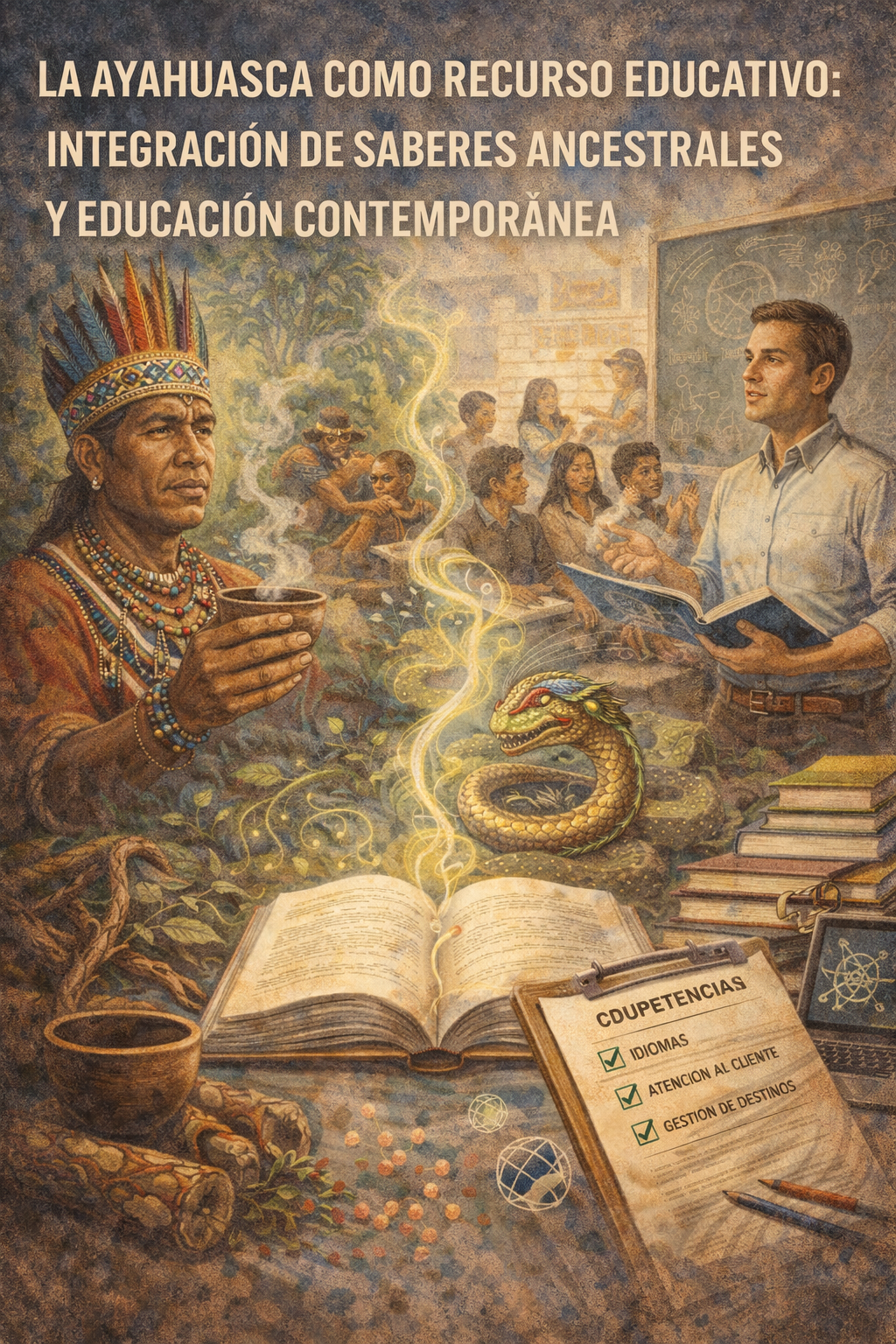
The Ayahuasca as an educational resource: integrating ancestral knowledge and contemporary education
Ayahuasca and educational background
DOI:
https://doi.org/10.56124/sapientiae.v9i19.007Keywords:
Ayahuasca, knowledge, education, interculturality, resourcesAbstract
Ayahuasca, an ancestral beverage used by indigenous peoples of the Amazon, has transcended its ritual and medicinal use to become a significant resource within intercultural educational processes. This sacred brew not only represents a symbol of indigenous worldview but also acts as a bridge to integrate ancestral knowledge with contemporary educational approaches. The incorporation of ayahuasca in educational spaces fosters the recognition and appreciation of traditional knowledge, promoting a respectful dialogue between indigenous and scientific epistemologies. In the pedagogical realm, ayahuasca can be used to strengthen cultural identity, stimulate critical thinking, and raise awareness about the importance of environmental care and sustainability. Likewise, its study contributes to a more contextualized, inclusive, and relevant education for both indigenous and non-indigenous communities. However, it is essential to approach this integration responsibly, respecting cultural practices and avoiding cultural appropriation. The present work aims to explore how ayahuasca can become an educational tool that fosters interculturality, the revitalization of traditions, and the construction of plural knowledge. In this way, it proposes an educational model that fosters dialogue between ancestral heritage and contemporary challenges, promoting a comprehensive education that enriches all generations.
Downloads
References
Albuquerque, M. B. (2018). Ayahusca’s Pedagogy: For an epistemic decolonization of knowledge. Education Policy Analysis Archives 26(1), 85. https://doi.org/10.14507/epaa.26.3519
Dupuis, D. (2018). Prácticas en búsqueda de legitimidad: el uso contemporáneo de la ayahuasca, entre reivindicaciones terapéuticas y religiosas. Revista de Salud Pública, 14(2), 341–354. https://doi.org/10.15446/rsap.v14n2.73556
Gonçalves, J., Luís, Â., Gallardo, E., & Duarte, A. P. (2023). A systematic review on the therapeutic effects of ayahuasca. Plants, 12(13), 2573. https://doi.org/10.3390/plants12132573
Grof, S. (2008). La mente holotrópica. Kairós.
Hinojosa Becerra, M., López Fernández, M. A., Estrella, M. L. G., & Marín Gutiérrez, I. (2017). El documental antropológico sobre el ritual de la ayahuasca en Zamora-Chinchipe. Educación, Arte, Comunicación: Revista Académica e Investigativa, 4. https://doi.org/10.13140/RG.2.1.1983.1122
Labate, B. C., and Cavnar, C. (2014). The Therapeutic Use of Ayahuasca. Springer.
Naranjo, P. (1979). Hallucinogenic plant use and related indigenous belief systems in the Ecuadorian Amazon. Journal of Ethnopharmacology, 1(2), 121–145. https://doi.org/10.1016/0378-8741(79)90004-7
Palhano-Fontes, F., Barreto, D., Onias, H., Andrade, K. C., Novaes, M. M., Pessoa, J. A., and Riba, J. (2019). Rapid antidepressant effects of the psychedelic ayahuasca in treatment-resistant depression: a randomized placebo-controlled trial. Psychological Medicine, 49(4), 655–663. https://doi.org/10.1017/S0033291718001356
Salibová, D. (2021). Ayahuasca ethno-tourism and its impact on the indigenous Shuar community (Ecuador) and Western participants. Český lid, 107(4), 511–532. https://doi.org/10.21104/CL.2020.4.05
Schultes, R. E., and Hofmann, A. (1992). Plantas de los dioses: orígenes del uso de los alucinógenos. Fondo de Cultura Económica.
Tupper, K. W. (2002). Entheogens and existential intelligence: The use of plant teachers as cognitive tools. Canadian Journal of Education, 27(4), 499–516.
Tupper, K. W. (2003). Entheogens & education: Exploring the potential of psychoactives as educational tools. Journal of Drug Education and Awareness, 1(2), 145–161
Published
How to Cite
Issue
Section
License
Copyright (c) 2025 Revista Científica Multidisciplinaria SAPIENTIAE. ISSN: 2600-6030.

This work is licensed under a Creative Commons Attribution-NonCommercial-ShareAlike 4.0 International License.


2.jpg)