Resiliencia, género y trayectorias académicas: factores que influyen en la persistencia de mujeres en carreras universitarias STEM
DOI:
https://doi.org/10.56124/sapientiae.v9i20.007Palabras clave:
Persistencia académica subjetiva, Autoeficacia, Resiliencia académica, Género y educación superior, Clima de género y mujeres en STEMResumen
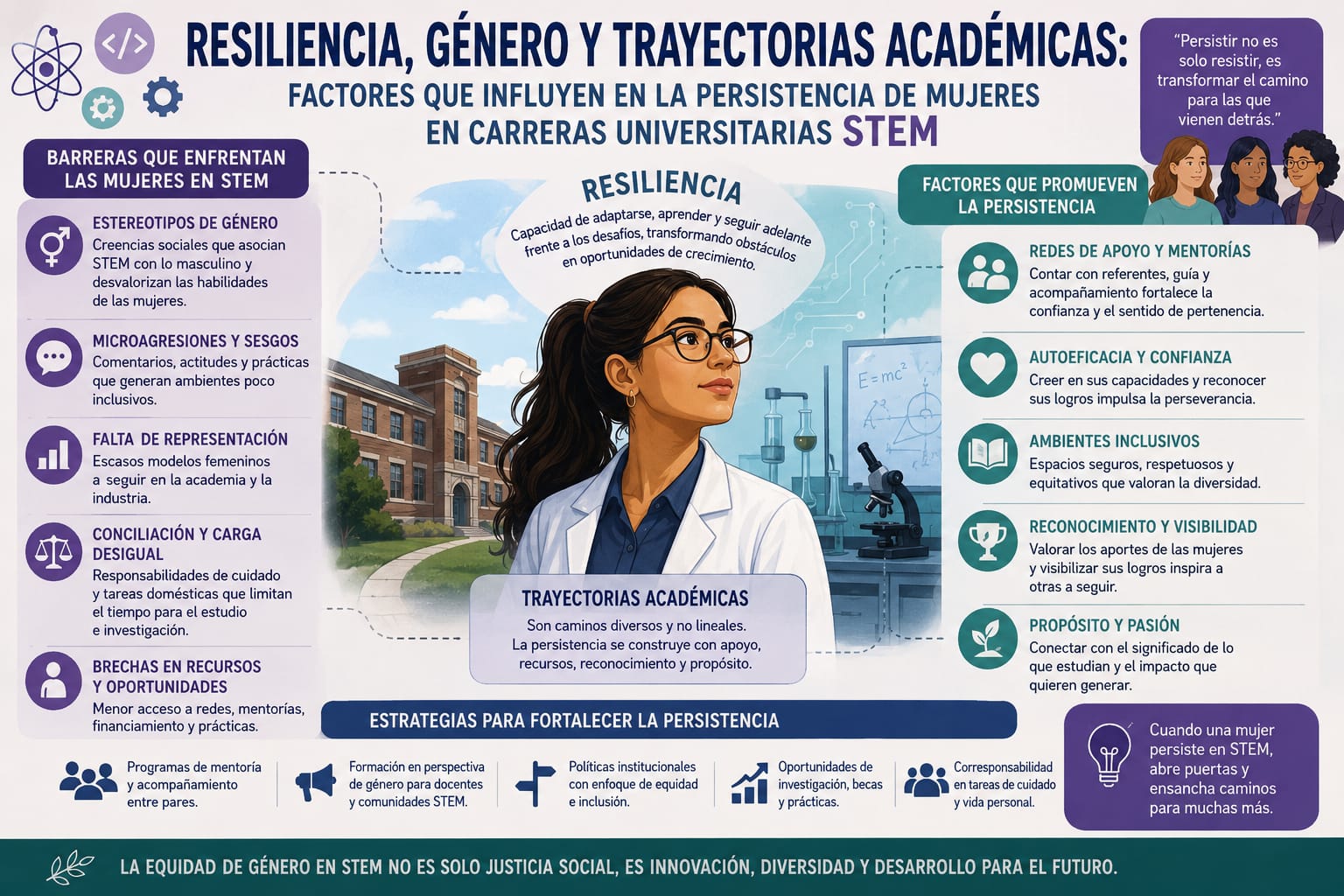
La subrepresentación femenina en las disciplinas científicas y técnicas vinculadas al desarrollo tecnológico, innovación e investigación aplicada (STEM), continúa siendo un desafío asociado a factores individuales, institucionales y socioculturales que influyen en las trayectorias académicas. Analizar estos elementos permite comprender la persistencia académica subjetiva, entendida en términos de compromiso, motivación y expectativas de graduación. Este estudio analizó los factores que inciden en la permanencia de mujeres ecuatorianas en programas STEM, a partir de la teoría sociocognitiva de la carrera y la teoría de la autoeficacia. Se aplicó una encuesta a 150 estudiantes y se construyeron índices de origen social, autoeficacia STEM, clima de género, apoyo académico y persistencia, con adecuada validación psicométrica. Mediante análisis de conglomerados se identificaron dos perfiles: estudiantes vulnerables y estudiantes favorables con alta persistencia. Las pruebas de contraste evidenciaron diferencias significativas entre ambos grupos en todos los índices. Los modelos de regresión robusta y logística indicaron que la autoeficacia STEM es el predictor más consistente de la persistencia, mientras que un clima de género desfavorable actúa en sentido inhibidor. Los resultados dejan ver que la permanencia se vincula con procesos de resiliencia académica frente a entornos adversos y ofrecen fundamentos analíticos para orientar políticas y estrategias dirigidas a reducir brechas de género y fortalecer el desarrollo académico y profesional.
Descargas
Citas
Asher, M. W., Harackiewicz, J. M., Beymer, P. N., Hecht, C. A., Lamont, L. B., Else-Quest, N. M., Priniski, S. J., Thoman, D. B., Hyde, J. S., & Smith, J. L. (2023). Utility-value intervention promotes persistence and diversity in STEM. Proceedings of the National Academy of Sciences of the United States of America, 120(19), e2300463120. https://doi.org/10.1073/PNAS.2300463120
Bandura, A. (1977). Self-efficacy: Toward a unifying theory of behavioral change. Psychological Review, 84(2), 191–215. https://doi.org/10.1037/0033-295X.84.2.191
Blaique, L., Pinnington, A., & Aldabbas, H. (2023). The influence of protean attitude for women in STEM careers: coping-self efficacy as foundational and strong career identity as outcome. Gender in Management, 38(8), 1092–1116. https://doi.org/10.1108/GM-06-2022-0200
Blickenstaff, J. C. (2005). Women and science careers: Leaky pipeline or gender filter? Gender and Education, 17(4), 369–386. https://doi.org/10.1080/09540250500145072
Buck, G. A., Francis, D. C., & Wilkins-Yel, K. G. (2020). Research on gender equity in STEM education. Handbook of Research on STEM Education, 289–299. https://doi.org/10.4324/9780429021381
Calderón Méndez, P. G., & Magaña Medina, D. E. (2025). Autoeficacia y acciones de elección por disciplinas STEM en estudiantes: Una revisión sistemática. Revista San Gregorio, 1(61), 63–74. https://doi.org/10.36097/rsan.v1i61.3232
Casad, B. J., Hale, P., & Wachs, F. L. (2017). Stereotype threat among girls: Differences by gender identity and math education context. Psychology of Women Quarterly, 41(4), 513–529. https://doi.org/10.1177/0361684317711412
Ceglédi, T., Fényes, H., & Pusztai, G. (2022). The Effect of Resilience and Gender on the Persistence of Higher Education Students. Social Sciences 2022, Vol. 11, Page 93, 11(3), 93. https://doi.org/10.3390/SOCSCI11030093
CES. (2018). Reglamento para garantizar la igualdad en la educación superior.
Charleston, L. V., & Leon, R. (2016). Constructing self-efficacy in STEM graduate education. Journal for Multicultural Education, 10(2), 152–166. https://doi.org/10.1108/JME-12-2015-0048
Cheryan, S., Lombard, E. J., Hailu, F., Pham, L. N. H., & Weltzien, K. (2024). Global patterns of gender disparities in STEM and explanations for their persistence. Nature Reviews Psychology 2024 4:1, 4(1), 6–19. https://doi.org/10.1038/s44159-024-00380-3
Cruz, M., & Nagy, N. (2024). Profiles in persistence: A latent profile analysis of multilevel coping strategies enacted among women in the sciences. Journal of Organizational Behavior, 45(3), 362–381. https://doi.org/10.1002/JOB.2657
Cunningham, B., Mulvaney Hoyer Dinah Sparks, K., & Ralph, J. (2015). Gender Differences in Science, Technology, Engineering, and Mathematics (STEM) Interest, Credits Earned, and NAEP Performance in the 12th Grade. Stats in Brief. NCES 2015-075. National Center for Education Statistics, 75.
Dickson, M., & Alharthi, M. (2025). “What do I wish I had known? Don’t expect the road to be full of flowers”: Advice from female STEM leaders in the GCC countries to younger women working in STEM fields. Social Sciences & Humanities Open, 11, 101502. https://doi.org/10.1016/J.SSAHO.2025.101502
Elvira-Zorzo, M. N., Gandarillas, M. Á., & Martí-González, M. (2025). Psychosocial Differences Between Female and Male Students in Learning Patterns and Mental Health-Related Indicators in STEM vs. Non-STEM Fields. Social Sciences 2025, Vol. 14, Page 71, 14(2), 71. https://doi.org/10.3390/SOCSCI14020071
Estrada, M., Hernandez, P. R., & Schultz, P. W. (2018). A Longitudinal Study of How Quality Mentorship and Research Experience Integrate Underrepresented Minorities into STEM Careers. Https://Doi.Org/10.1187/Cbe.17-04-0066, 17(1). https://doi.org/10.1187/CBE.17-04-0066
For Women in Science. (2025). For Women in Science. https://www.forwomeninscience.com/
García-Silva, E., Pérez-Suarez, S., Zavala-Parrales, A., Meléndez-Anzures, F. E., & Domínguez, Á. (2025). Continuing education of academic women in STEM: perspectives on mentoring and professional roles. Frontiers in Education, 10, 1473331. https://doi.org/10.3389/FEDUC.2025.1473331
Goldin, C. (2006). The Quiet Revolution That Transformed Women's Employment, Education, and Family. American Economic Review, 96(2), 1–21. https://doi.org/10.1257/000282806777212350
Halim, L., Rahman, N. A., Ramli, N. A. M., & Mohtar, L. E. (2018). Influence of students’ STEM self-efficacy on STEM and physics career choice. AIP Conference Proceedings, 1923(1). https://doi.org/10.1063/1.5019490/761949
Hernández, A., Aguilar, C., Paradell, È., Muñoz, M. R., Vannier, L. C., & Vallar, F. (2017). El efecto de las variables demográficas en la evaluación de la aptitud cognitiva. Psicothema, 29(4), 469–474. https://doi.org/10.7334/PSICOTHEMA2017.33
INEC. (2019). Encuesta Nacional de Empleo, Desempleo y Subempleo. https://www.ecuadorencifras.gob.ec/empleo-desempleo-y-subempleo/
Keller, E. F. (1985). Reflections on gender and science.
Koul, R. B., McLure, F. I., & Fraser, B. J. (2023). Gender differences in classroom emotional climate and attitudes among students undertaking integrated STEM projects: a Rasch analysis. Research in Science and Technological Education, 41(3), 1051–1071. https://doi.org/10.1080/02635143.2021.1981852
Lee, H., Du, W., Pedersen, R. M., Estrada, M., Adams, A. S., Barnes, R. T., Bloodhart, B., Burt, M., Clinton, S. M., Pollack, I., Fischer, E. V., & Hernandez, P. R. (2024). To stay, switch, or leave: A four-year longitudinal study of the situated and stable social influences on women’s STEM major choices. Contemporary Educational Psychology, 79, 102324. https://doi.org/10.1016/J.CEDPSYCH.2024.102324
Lent, R. W., Brown, S. D., & Hackett, G. (1994). Toward a Unifying Social Cognitive Theory of Career and Academic Interest, Choice, and Performance. Journal of Vocational Behavior, 45(1), 79–122. https://doi.org/10.1006/JVBE.1994.1027
López, P., Simó, P., & Marco, J. (2023). Understanding STEM career choices: A systematic mapping. Heliyon, 9(6), e16676. https://doi.org/10.1016/J.HELIYON.2023.E16676
Masten, A. S. (2001). Ordinary magic: Resilience processes in development. American Psychologist, 56(3), 227–238.
https://doi.org/10.1037/0003-066X.56.3.227
Masten, A. S. (2014). Ordinary Magic: Resilience in Development. New York: Guilford Press.
https://www.guilford.com/books/Ordinary-Magic/Ann-Masten/9781462514700
Mills, I. M., & Mills, B. S. (2018). Insufficient evidence: mindset intervention in developmental college math. Social Psychology of Education, 21(5), 1045–1059. https://doi.org/10.1007/s11218-018-9453-y
Ortiz-Martínez, G., Vázquez-Villegas, P., Ruiz-Cantisani, M. I., Delgado-Fabián, M., Conejo-Márquez, D. A., & Membrillo-Hernández, J. (2023). Analysis of the retention of women in higher education STEM programs. Humanities and Social Sciences Communications, 10(1), 1–14. https://doi.org/10.1057/S41599-023-01588-Z
Robnett, R. D., & Thoman, S. E. (2017). STEM success expectancies and achievement among women in STEM majors. Journal of Applied Developmental Psychology, 52, 91–100. https://doi.org/10.1016/J.APPDEV.2017.07.003
Şahin, E., Sarı, U., & Şen, Ö. F. (2024). STEM professional development program for gifted education teachers: STEM lesson plan design competence, self-efficacy, computational thinking and entrepreneurial skills. Thinking Skills and Creativity, 51, 101439. https://doi.org/10.1016/J.TSC.2023.101439
Schmader, T. (2023). Gender Inclusion and Fit in STEM. Annual Review of Psychology, 74, 219–243. https://doi.org/10.1146/ANNUREV-PSYCH-032720-043052
Setlogelo, B., & Nyoni, C. N. (2024). Grit, academic resilience, and mindset of nursing students: A cross-sectional study. International Journal of Nursing Studies Advances, 7, 100253. https://doi.org/10.1016/J.IJNSA.2024.100253
Sikhosana, H., Malatji, H., & Munyoro, A. (2023). Experiences and challenges of black women enrolled in a STEM field in a South African urban university: A qualitative study. Cogent Education, 10(2). https://doi.org/10.1080/2331186X.2023.2273646
Tao, S., Law, N. W. Y., & Ko, P. (2025). Parental Involvement and Students’ STEM Self-efficacy in Hong Kong: A Multigroup Analysis of Gender and Age Disparities. International Journal of Science and Mathematics Education 2025 23:7, 23(7), 3069–3091. https://doi.org/10.1007/S10763-025-10568-5
UNESCO. (2019). Descifrar el código: la educación de las niñas y las mujeres en ciencias, tecnología, ingeniería y matemáticas (STEM). 83. https://unesdoc.unesco.org/ark:/48223/pf0000366649
UNESCO. (2022). W‐STEM Project - Erasmus+. https://wstemproject.eu/
UNESCO. (2024a). Changing the equation : securing STEM futures for women. https://unesdoc.unesco.org/ark:/48223/pf0000391384
UNESCO. (2024b). The gender gap in science: Status and trends.
UNESCO. (2025). UNESCO launches “Imagine a world with more women in science.” https://www.unesco.org/en/articles/unesco-launches-imagine-world-more-women-science-campaign
Vera Gil, S. (2024). The Influence of Gender on Academic Performance and Psychological Resilience, and the Relationship Between Both: Understanding the Differences Through Gender Stereotypes. Trends in Psychology, 1–20. https://doi.org/10.1007/S43076-024-00370-7
Werner, A. J., & Bixby, T. J. (2024). Targeting Persistence: Student Profiles Reveal Strengths and Challenges in Chemistry and Biochemistry Undergraduate Student Development. Journal of Chemical Education, 101(10), 4114–4123. https://doi.org/10.1021/ACS.JCHEMED.4C00610
Werner, E. E. (1982). Resilient children and youth: A longitudinal study from birth to adulthood. Journal of the American Academy of Child Psychiatry, 21(6), 593–600.
https://doi.org/10.1097/00004583-198211000-00019
Zhou, X., Shu, L., Chen, T., Xu, Z., & Padrón, Y. (2025). Improving K–12 STEM teacher self-efficacy: a scoping review of experimental professional development trials. Professional Development in Education. https://doi.org/10.1080/19415257.2025.2544293
Zúñiga-Tinizaray, F. S., & Marín, V. I. (2024). Estrategias Educativas STEM-STEAM en Nivel Superior: Revisión Sistemática de Literatura. Revista Espacios, 45(4), 16–30. https://doi.org/10.48082/ESPACIOS-A24V45N04P02
Publicado
Cómo citar
Número
Sección
Licencia
Derechos de autor 2026 Revista Científica Multidisciplinaria SAPIENTIAE. ISSN: 2600-6030

Esta obra está bajo una licencia internacional Creative Commons Atribución-NoComercial-CompartirIgual 4.0.


2.jpg)