Pronunciation Difficulties Among B1 Ecuadorian EFL Students: Causes and Classroom Solutions
DOI:
https://doi.org/10.56124/sapientiae.v9i20.023Keywords:
pronunciation; English as a foreign language; communicative competence; linguistic interference; pronunciation teachingAbstract
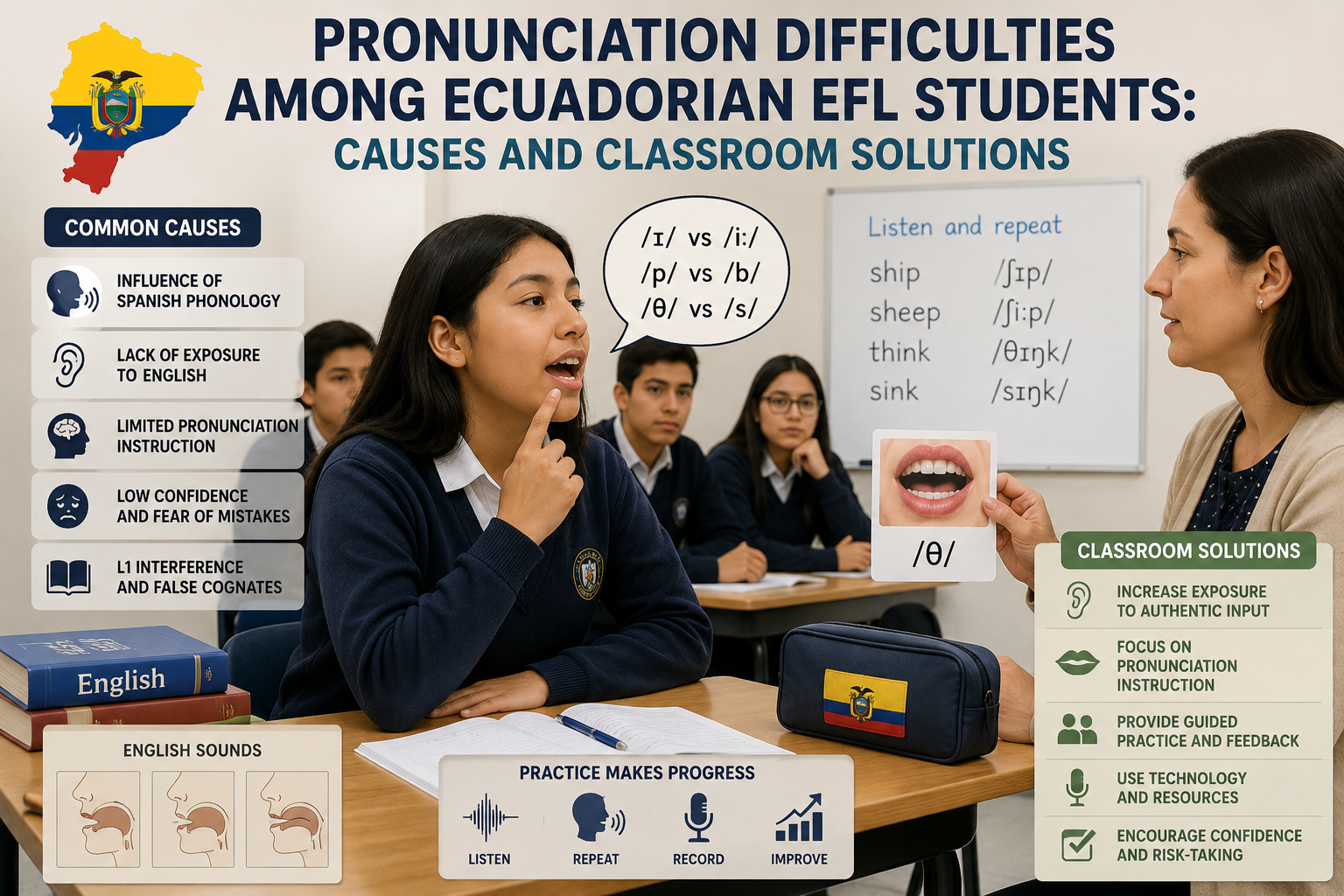
Pronunciation is an essential component of communicative competence in learning English as a foreign language, as it directly influences intelligibility and oral interaction. However, in the Ecuadorian educational context, B1-level students experience persistent difficulties that affect their communicative performance. The objective of this study is to analyze the main pronunciation difficulties of Ecuadorian B1-level students, identify their causes, and propose pedagogical solutions. The research used a literature review design, analyzing theoretical and empirical studies published between 2015 and 2026 in academic databases and institutional repositories. The results show that the most frequent difficulties are related to Spanish interference, limited exposure to authentic English, lack of explicit instruction, and affective factors such as anxiety. Furthermore, pronunciation tends to receive less attention in the classroom than other language skills. The study concludes that it is necessary to implement systematic pronunciation instruction that combines explicit instruction, communicative activities, technology, and low-anxiety learning environments. These strategies contribute to improving students' intelligibility, confidence, and communicative competence.
Downloads
References
Al-Asi, N. M. (2024). Chant-based phonics for EFL pronunciation accuracy. CELTI Proceedings, 2(1), 421–435. https://proceedings.uinsaizu.ac.id/index.php/celti/article/download/521/446
Alghazo, S., Jarrah, M., & Al Salem, M. N. (2023). The efficacy of the type of instruction on second language pronunciation acquisition. Frontiers in Education, 8, 1182285. https://doi.org/10.3389/feduc.2023.1182285
Anggraini, A. (2022). Improving students' pronunciation skill using ELSA Speak application. Journey, 5(1), 135-141. DOI: 10.33503/journey.v5i1.1840
Armas, G., & Pila, M. (2025). Exploring effective approaches to pronunciation instruction in foreign language learning: A case study in English language teaching in Ecuadorian public schools. Pacha: Revista de Estudios Contemporáneos del Sur Global, 6(19). https://doi.org/10.46652/pacha.v6i19.443
Barone, S. (2024). The importance of interlanguage in language teaching: an analysis of its development in L2 learners. Vestnik of Samara State Technical University Psychological and Pedagogical Sciences, 21(3), 81–97. https://doi.org/10.17673/vsgtu-pps.2024.3.6
Barriuso, T. A., & Hayes-Harb, R. (2018). High variability phonetic training as a bridge from research to practice. The CATESOL Journal, 30(1). https://doi.org/10.5070/B5.35970
Best, C. T. (1995). A direct realist view of cross-language speech perception. In W. Strange (Ed.), Speech perception and linguistic experience: Issues in cross-language research (pp. 171–204). York Press.
Bonilla, M. H., & Fernández, M. C. (2025). Teaching phonics to EFL adult learners. Kronos–The Language Teaching Journal, 5(2), 85-94. https://revistadigital.uce.edu.ec/index.php/KronosJournal/article/view/7432
Caisaguano Tigasi, G. A. (2024). Factors affecting speaking and pronunciation skills of EFL learners. [Undergraduate thesis, Universidad de Cuenca]. Repositorio institucional de la UC. http://dspace.ucuenca.edu.ec/bitstream/123456789/39645/1/Trabajo-de-Titulaci%C3%B3n.pdf
Choe, S., Park, H., & Ahn, H. (2025). The Efficacy of High Variability Phonetic Training for L2 Speech Perception in EFL Contexts: A Meta-Analytic Approach. 영어학, 25, 1416-1443. DOI: 10.15738/kjell.25..202510.1416
Garellek, M. (2022). Theoretical achievements of phonetics in the 21st century: Phonetics of voice quality. Journal of Phonetics, 94, 101155. https://www.sciencedirect.com/science/article/pii/S0095447022000304
Garellek, M., & Keating, P. (2011). The acoustic consequences of phonation and tone interactions in Jalapa Mazatec. Journal of the International Phonetic Association, 41(2), 185–205. https://doi.org/10.1017/S0025100311000193
Gordon, M., & Ladefoged, P. (2001). Phonation types: a cross-linguistic overview. Journal of phonetics, 29(4), 383-406. https://www.sciencedirect.com/science/article/pii/S0095447001901470
Kang, O. (2022). Salient prosodic features on judgments of second language accent. https://www.isca-archive.org/speechprosody_2010/kang10_speechprosody.pdf
Kotake, N. (2024). Shadowing with ASR for fluency gains. System, 118, 103156. https://doi.org/10.1016/j.system.2024.103156
Krashen, S. D. (1982). Principles and practice in second language acquisition. Pergamon Press. https://n9.cl/siyxb
Kunova, R., & Kralova, Z. (2025). A Systematic Review of Experimental Methods in EFL Pronunciation Enhancement: Trends, Technologies, and Gaps. In Forum for Linguistic Studies. 7(10) 165-178. https://journals.bilpubgroup.com/index.php/fls
Levis, J. M. (2018). Intelligibility, oral communication, and the teaching of pronunciation. Cambridge University Press. https://doi.org/10.1017/9781108241564
Majidi, K., Rezai, M. J., Fazilatfar, A. M., & Elhambakhsh, S. E. (2025). The Impact of Gamified Formative Assessment on Writing Complexity, Accuracy, and Fluency: A Macro-Level Investigation in the Iranian EFL Context. Applied Research on English Language, 14(3), 123-152. DOI: 10.22108/ARE.2025.145062.2512
Martinez Cajilima, E. D., & Pauta Chalco, D. P. (2025). Explicit phonetics instruction and its impact on speaking proficiency in Ecuadorian EFL learners [Undergraduate thesis, Universidad de Cuenca]. Repositorio Institucional de la UC. https://dspace.ucuenca.edu.ec/handle/123456789/47618
McKinnon, K. (2025). Peer feedback loops in pronunciation clinics. TESOL Journal, 16(1), e712. https://doi.org/10.1002/tesj.712
Moncayo Herrera, E. (2023). Improving pronunciation of -S ending in an Ecuadorian EFL class. Research, Society and Development, 12(12), e43995. https://doi.org/10.33448/rsd-v12i12.43995.
Panyathikul, W., & Poopatwiboon, S. (2025). Improving EFL Secondary Learners' Pronunciation through Multimodal Teaching. Journal of Education and Learning, 14 (1), 148-160. https://doi.org/10.5539/jel.v14n1p148
Paredes-Riera, J. (2020). A real skills perspective based on human relationships and modes of behavior. The International Journal of Interdisciplinary Cultural Studies, 14(2), 27–32. https://doi.org/10.18848/2327-008X/CGP/v14i02/27-32
Pennington, M. C. (2021). Teaching pronunciation: The state of the art 2021. RELC Journal, 52(1), 8–23. https://doi.org/10.1177/00336882211002283
Pérez, C. V. (2026). Examining English pronunciation instruction in Galician secondary education textbooks. Porta Linguarum: revista internacional de didáctica de las lenguas extranjeras, (45), 155-172. https://dialnet.unirioja.es/servlet/articulo?codigo=10608616
Pesantez, A., & Dellwo, V. (2023). A longitudinal study of individual difference in foreign language pronunciation development: The case of vowel production in Ecuadorian learners of English. In Proceedings of the 7th International Conference on English Pronunciation: Issues and Practices (pp. 214-224). https://hal.science/hal-04178917/
Ping, L., & Tao, N. (2025). Innovative approaches to English pronunciation instruction in ESL contexts: integration of multi-sensor detection and advanced algorithmic feedback. Frontiers in Psychology, 15, 1484630. https://doi.org/10.3389/fpsyg.2024.1484630
Qian, Bojie and Diana Deris, Farhana, A. (2023). Corpus-based Pronunciation Teaching Model: A Conceptual Paper Arab World English Journal (AWEJ), Volume 14. Number 1 March 2023 , Available at SSRN: https://ssrn.com/abstract=4431280 or http://dx.doi.org/10.2139/ssrn.4431280
Rodríguez Ludeña, M. P. (2019). Dificultades que presentan los aprendices de inglés como lengua extranjera en la pronunciación de los sonidos vocálicos /ɪ/, /ʌ/, /ʊ/, /ə/. Revista Andina de Educación, 2(1), 29–34. https://doi.org/10.32719/26312816.2019.2.1.5
Rodríguez, S. E. G. (2025). Ecuadorian EFL teachers’ experiences in fostering students’ speaking skills. Unesum Ciencias, 1(1), 1–15. https://revistas.unesum.edu.ec/index.php/unesumciencias/article/view/929
Rojas Miranda, S. N., & Venegas Alvarez, G. S. (2025). Abordar los desafíos de pronunciación en estudiantes de EFL a través del método fonético. Revista Científica de Innovación Educativa y Sociedad Actual “ALCON”, 5(4), 201–221. https://doi.org/10.62305/alcon.v5i4.684
Saito, K. (2021). What characterizes comprehensible and native-like pronunciation among ESL speakers? TESOL Quarterly, 55(3), 866–900. https://doi.org/10.1002/tesq.3027
Sarango Ajila, C. S., & Nesterenko, N. A. (2022). Pronunciation difficulties in Ecuadorian EFL learners [Undergraduate thesis, Universidad Técnica Particular de Loja]. Repositorio institucional de la UTPL. https://dspace.utpl.edu.ec/handle/20.500.11962/23793
Szpyra-Kozłowska, J., & Stasiak, S. (2016). Verifying a holistic multimodal approach to pronunciation training of intermediate Polish learners of English. Lublin Studies in Modern Languages and Literature, 40(1). https://journals.umcs.pl/lsmll/article/view/2571
Thomson, R. I. (2018). High variability pronunciation training (HVPT): A proven technique about which every language teacher and learner ought to know. Journal of Second Language Pronunciation, 4(2), 208–231. https://doi.org/10.1075/jslp.17038.tho
Toasa Cruz, T. M. (2022). Flipped classroom and /st/ consonant cluster pronunciation in the Ecuadorian EFL classroom [Master’s thesis, Pontificia Universidad Católica del Ecuador]. Repositorio institucional de la PUCE. https://repositorio.puce.edu.ec/handle/123456789/9361
Published
How to Cite
Issue
Section
License
Copyright (c) 2026 Revista Científica Multidisciplinaria SAPIENTIAE. ISSN: 2600-6030.

This work is licensed under a Creative Commons Attribution-NonCommercial-ShareAlike 4.0 International License.


2.jpg)