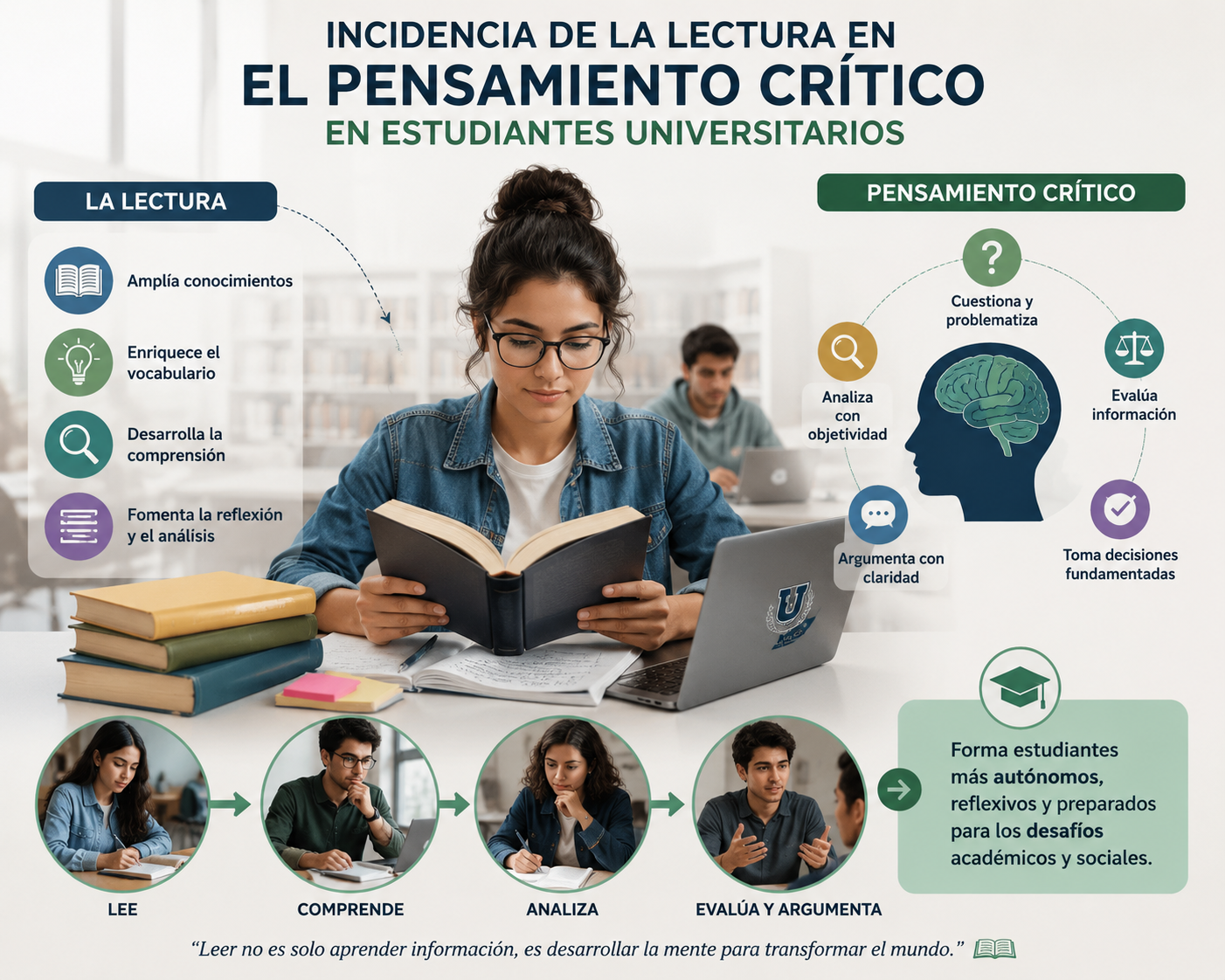
Incidencia de la lectura en el pensamiento crítico en estudiantes universitarios caso de estudio Facultad de Ciencias de la Educación, Carrera de Educación Física
DOI:
https://doi.org/10.56124/sapientiae.v9i20.016Keywords:
Reading habits, critical thinking, higher education, university students, Manabí.Abstract
The development of critical thinking is a fundamental competency in higher education, closely linked to students' analytical, synthetic, and evaluative capacities. This study addresses the gap between limited engagement in systematic reading habits and low levels of critical thinking within the university context of Manabí. The purpose was determining the relationship between the frequency of reading habits and the level of critical thinking development among Physical Education students. A quantitative, non-experimental correlational design was employed. The sample consisted of 156 students, who completed two instruments: a reading habits questionnaire and a standardized critical thinking test focused on analyzing fallacies and logical flaws. Significant positive correlations were identified between both variables. Notably, students who enjoy reading are 5.3 times more likely to demonstrate high critical quality compared to those with weak habits. Factors such as a reading-oriented family environment and reading for pleasure proved to be more potent predictors than mandatory academic reading. It is concluded that reading habits are a decisive and significant factor for critical thinking. These findings support the implementation of institutional programs that go beyond utilitarian reading and promote critical and voluntary reading as a cross-cutting theme in universities.
Downloads
References
Afdila, N. y Sartika, S. B. (2021). A secondary school student’s critical thinking ability profile in natural science subject matters based on learning style. INSECTA: Integrative Science Education and Teaching Activity Journal, 1(2), 175–182. https://doi.org/10.21154/INSECTA.V1I2.2230
Albeni, S., Recepoğlu, S. y Öztürk, D. (2023). Examination of the relationship between reasoning styles and critical thinking skills of pre-service social studies teachers. International Journal of Eurasian Education and Culture, 8(22). https://doi.org/10.35826/ijoecc.710
Alcas Zapata, N., Alarcón Diaz, M. A., Alarcón Diaz, H. H., Gonzáles LLontop, R. y Rodríguez Fuentes, A. (2019). Estrategias metacognitivas y comprensión lectora en estudiantes universitarios. Apuntes Universitarios, 9(1), 36–45. https://doi.org/10.17162/AU.V9I1.348
Andreucci-Annunziata, P., Riedemann, A., Cortés, S., Mellado, A., Del Río, M. T., & Vega-Muñoz, A. (2023). Conceptualizations and instructional strategies on critical thinking in higher education: A systematic review of systematic reviews. Frontiers in Education, 8, 1141686. https://doi.org/10.3389/feduc.2023.1141686
Bakdash, J. Z., & Marusich, L. R. (2017). Repeated measures correlation. Frontiers in Psychology, 8, 456. https://doi.org/10.3389/fpsyg.2017.00456
García-Párraga, A. R., Macías-Ordoñez, L. M. y Cusme-Santander, C. F. (2016). Hábito de lectura en estudiantes de Centro de Educación Superior, Manta provincia de Manabí. Dominio de las Ciencias, 2(2), 280–290. https://scispace.com/papers/habito-de-lectura-en-estudiantes-de-centro-de-educacion-71odxl6u29
Google. (2026). Google Forms [Software]. https://www.google.com/forms/about/
Henríquez Coronel, M. A., Castillo Quintero, H. P. y Tubay, F. M. (2020). Hábitos de lectura en alumnos universitarios de la carrera de educación en la Universidad Técnica de Manabí, Ecuador. Revista Cognosis, 5(2), 33. https://doi.org/10.33936/COGNOSIS.V5I2.2201
Lamas Lara, C. A., Martinez Del Rio, I. P., Beltran Pineda, L. B., & Romero Vela, S. L. (2025). Aprendizaje basado en investigación: Desarrollo del pensamiento crítico en educación superior. Horizontes. Revista de Investigación en Ciencias de la Educación, 9(40), 410–426. https://doi.org/10.33996/revistahorizontes.v9i40.1152
Moon, J. (2007). Critical thinking: An exploration of theory and practice. Routledge. https://doi.org/10.4324/9780203944882
Muñoz-Campos, V. (2025). Critical and analytical thinking: Unique and overlapping aspects from the perspective of teacher candidates. Educational Policy Analysis and Strategic Research, 20(2), 32-57. https://files.eric.ed.gov/fulltext/EJ1477014.pdf
Pedaste, M., Mäeots, M., Siiman, L. A., De Jong, T., van Riesen, S. A., Kamp, E. T., y Tsourlidaki, E. (2015). Phases of inquiry-based learning: Definitions and the inquiry cycle. Educational Research Review, 14, 47-61. https://doi.org/10.1016/j.edurev.2015.02.003
Paul, R. & Elder L. (2005). Estándares de competencias para el pensamiento crítico. Recuperado_de http://www.criticalthinking.org/resources/PDF/SPComp_Standards.pdf
Rumrill, Jr., P. D. (2004). Non-manipulation quantitative designs. WORK: A Journal of Prevention, Assessment & Rehabilitation, 22(3), 255–260. https://doi.org/10.3233/WOR-2004-00362
Schober, P., Boer, C., & Schwarte, L. A. (2018). Correlation Coefficients: Appropriate Use and Interpretation. Anesthesia & Analgesia, 126(5), 1763–1768. https://doi.org/10.1213/ANE.0000000000002864
Stanovich, K. E. (2009). What Intelligence Tests Miss: The Psychology of Rational Thought. Yale University Press. https://psycnet.apa.org/record/2008-06992-000
Stanovich, K. E., & West, R. F. (2000). Individual differences in reasoning: Implications for the rationality debate? Behavioral and Brain Sciences, 23(5), 645-665. https://doi.org/10.1017/S0140525X00003435
Straková, Z., & Cimermanová, I. (2018). Critical Thinking Development—A Necessary Step in Higher Education Transformation towards Sustainability. Sustainability, 10(10), 3366. https://doi.org/10.3390/su10103366
Turan, U., Fidan, Y., & Yıldıran, C. (2019). Critical Thinking as a Qualified Decision Making Tool. Journal of History Culture and Art Research, 8(4), 1. https://doi.org/10.7596/taksad.v8i4.2316
Grimard Wilson, D., & Wagner, E. E. (1981). The Watson-Glaser Critical Thinking Appraisal as a Predictor of Performance in a Critical Thinking Course. Educational and Psychological Measurement, 41(4), 1319–1322. https://doi.org/10.1177/001316448104100443
Published
How to Cite
Issue
Section
License
Copyright (c) 2026 Revista Científica Multidisciplinaria SAPIENTIAE. ISSN: 2600-6030.

This work is licensed under a Creative Commons Attribution-NonCommercial-ShareAlike 4.0 International License.

2.jpg)