Formative Assessment and its Impact on the Quality of Learning of Higher Education Students
DOI:
https://doi.org/10.56124/sapientiae.v9i20.022Keywords:
Keywords: Formative assessment, feedback, student autonomy, academic motivation, learning qualityAbstract
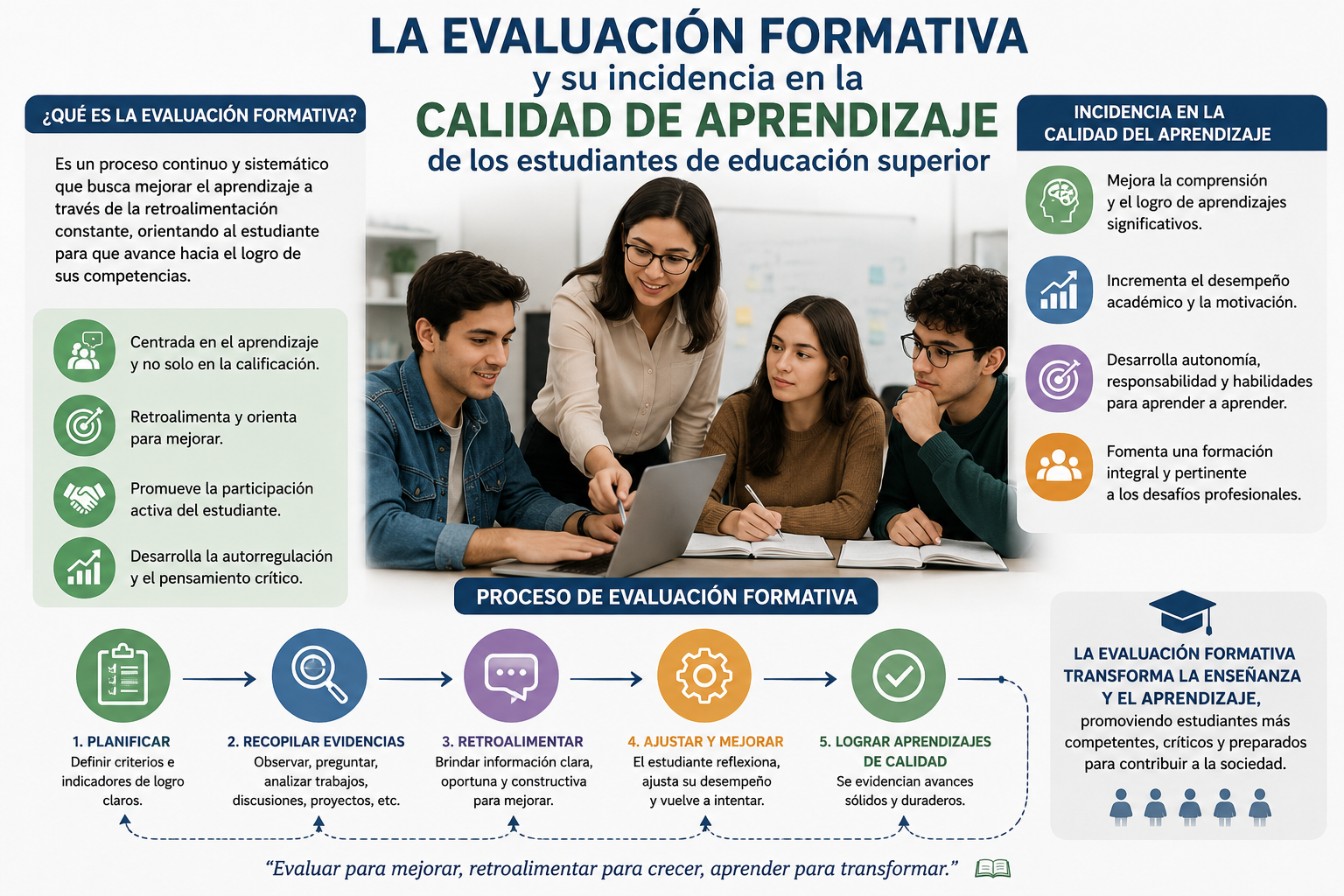
The study addresses formative assessment as a key strategy to improve the quality of learning in higher education students, especially in Latin American contexts such as that of the Eloy Alfaro Lay University of Manabí (ULEAM). Despite its potential to foster self-regulation, critical reflection, and educational equity, structural and cultural barriers that limit its effective implementation are identified. The research was developed under a descriptive quantitative approach, applying a Likert-type questionnaire to 400 students from 6 faculties, in order to explore their perceptions of evaluative practices. The reliability of the instrument was high (Cronbach's Alpha between 0.82 and 0.91), and it was validated through expert judgment and exploratory factor analysis. The results show that, although formative assessment is generally viewed positively, a neutral stance prevails in many areas, suggesting a partial or limited application of these strategies. For example, less than half of the students perceive that feedback helps them improve or that assessments promote reflection on their learning. However, a favorable perception is evident in aspects such as collaborative learning and inclusive teaching. Therefore, the study demonstrates that formative assessment has a positive impact on motivation, autonomy, and academic performance, but requires greater systematization, visibility, and teacher training.
Downloads
References
Bravo Mancero, P., & Santos Jiménez, O. (2019). Percepciones respecto a la atención a la diversidad o inclusión educativa en estudiantes universitarios. Sophia, Colección de Filosofía de la Educación, 26, 327–352. https://doi.org/10.17163/soph.n26.2019.13
Bustamante Bula, R., & Camacho Bonilla, A. (2024). Inteligencia artificial (IA) en las escuelas: una revisión sistemática (2019–2023). Enunciación, 29(1), 62–82. https://doi.org/10.14483/22486798.22039
Cañadas, L. (2020). Evaluación formativa en el contexto universitario: oportunidades y propuestas de actuación. Revista Digital de Investigación en Docencia Universitaria, 14(2), 1–10. https://doi.org/10.19083/ridu.2020.1214
Delgado, M., Herrera, S., & Ruiz, J. (2021). Evaluación formativa e inclusión educativa en contextos universitarios. Revista Iberoamericana de Educación, 86(1), 1–16. https://doi.org/10.35362/rie8611234
El Comercio. (2024). Deserción escolar y crisis de aprendizaje en Ecuador. El Comercio. https://www.elcomercio.com/opinion/editorial/desercion-escolar-y-crisis-de-aprendizaje-en-ecuador/
Flores Gómez, C., Villalobos-Vergara, P., & Maturana Castillo, D. (2022). Retroalimentación en las prácticas pedagógicas: interacciones entre supervisores universitarios y profesores en formación. Revista Digital de Investigación en Docencia Universitaria, 16(2), e1577. https://www.redalyc.org/journal/4985/498576699001/
Flores, C., & López, M. (2022). Delivering effective student feedback in higher education: An evaluation of the challenges and best practice. International Journal of Research in Education and Science, 10(2), 473–501. https://doi.org/10.46328/ijres.3404
Huamán Vargas, J., Solís Trujillo, B. P., Quispe Merma, F., & Silva Huamán, J. (2022). Evaluación formativa en educación superior: revisión sistemática. TecnoHumanismo, 2(4), 44–59. https://doi.org/10.38140/tecn.hum.v2i4.875
López, J., Martínez, L., & Paredes, F. (2020). Making feedback effective? Assessment in Education: Principles, Policy & Practice, 27(1), 1–5. https://doi.org/10.1080/0969594X.2020.1728908
López-Pastor, V., & Sicilia-Camacho, A. (2017). Formative and shared assessment in higher education: Lessons learned and challenges for the future. Assessment & Evaluation in Higher Education, 42(1), 77–97. https://doi.org/10.1080/02602938.2015.1083535
Martínez, R., López, S., & García, T. (2021). Evaluación formativa y motivación académica en estudiantes universitarios. Revista de Psicología Educativa, 27(1), 1–12. https://doi.org/10.1016/j.psicoe.2021.01.001
Ministerio de Educación. (2023). Estadística Educativa. Volumen 4. https://educacion.gob.ec/wp-content/uploads/downloads/2023/11/Estadistica-Educativa_Volumen-4.pdf
Molina Soria, M., Pascual Arias, C., & López Pastor, V. M. (2020). El rendimiento académico y la evaluación formativa y compartida en formación del profesorado. Alteridad, 15(2), 5–15. https://doi.org/10.17163/alt.v15n2.2020.05
Pacheco Mena, M. X., Cruz Carrera, E. Z., Bautista Plaza, F. J., & Chiliquinga Lema, S. J. (2025). Evaluación formativa y su influencia en el rendimiento académico de estudiantes de educación básica. Imaginario Social, 8(1), 1–10. https://doi.org/10.5281/zenodo.10293845
Panadero, E., Andrade, H., & Brookhart, S. M. (2018). Fusing self-regulated learning and formative assessment: A roadmap of where we are, how we got here, and where we are going. The Australian Educational Researcher, 45(1), 13–31. https://doi.org/10.1007/s13384-018-0258-y
Paredes, M., & Searle, M. (2023). Collaborative evaluation designs as an authentic course assessment. Canadian Journal of Program Evaluation, 38(2), 24–33. https://doi.org/10.3138/cjpe.69691
Pérez, L., Gómez, R., & Salinas, C. (2020). Autoevaluación y aprendizaje autónomo en la educación superior: percepciones estudiantiles. Revista de Investigación Educativa, 38(2), 1–18. https://doi.org/10.6018/rie.38.2.123456
Quintero, A. (2025). La evaluación formativa y su impacto en la educación superior. Prezi. https://prezi.com/p/fukrj8ubngmo/la-evaluacion-formativa-y-su-impacto-en-la-educacion-superior/
Ríos Muñoz, D., & Herrera Araya, D. (2023). Retroalimentación docente y autoevaluación de los estudiantes en educación superior: innovación evaluativa en la formación inicial de profesores de educación primaria. Revista Brasileira de Educação, 28, e280123. https://doi.org/10.1590/s1413-24782023280123
Rodríguez, M., Pérez, J., & Vargas, L. (2021). Evaluación formativa y retroalimentación en la educación superior: percepciones estudiantiles. Revista Electrónica Educare, 25(2), 1–20. https://doi.org/10.15359/ree.25-2.6
Salazar, J., Martínez, L., & Paredes, F. (2022). La retroalimentación formativa en la educación universitaria: análisis de prácticas docentes. Revista de Educación Superior del Sur, 10(1), 1–14. https://doi.org/10.35626/res.10.1.2022.123
Tapia Ramos, G. I., & Santa María Relaiza, H. R. (2025). Prácticas de evaluación formativa en educación: tendencias en Latinoamérica y el mundo. Ciencia y Humanismo, 26, 297–318. https://doi.org/10.37135/chk.002.26.14
Torres, A., Ramírez, L., & Gómez, C. (2022). Evaluación formativa y motivación en la educación superior: percepciones estudiantiles. Revista de Educación y Pedagogía, 34(1), 1–15. https://doi.org/10.17533/udea.rep.123456
ULEAM. (2019). Manual de seguimiento y evaluación de resultados de aprendizaje. https://departamentos.uleam.edu.ec/gestion-aseguramiento-calidad/files/2019/01/PAR-01-Manual-Seguimiento-y-evaluacion-de-resultados-de-aprendizaje-V1-1.pdf
Published
How to Cite
Issue
Section
License
Copyright (c) 2026 Revista Científica Multidisciplinaria SAPIENTIAE. ISSN: 2600-6030.

This work is licensed under a Creative Commons Attribution-NonCommercial-ShareAlike 4.0 International License.


2.jpg)