Herramientas clínicas para el diagnóstico de delirium en adultos hospitalizados en salas generales: revisión sistemática
DOI:
https://doi.org/10.56124/sapientiae.v9i20.015Keywords:
Delirium, Diagnóstico, Hospitalización, Herramientas de cribado, Evaluación cognitiva.Abstract
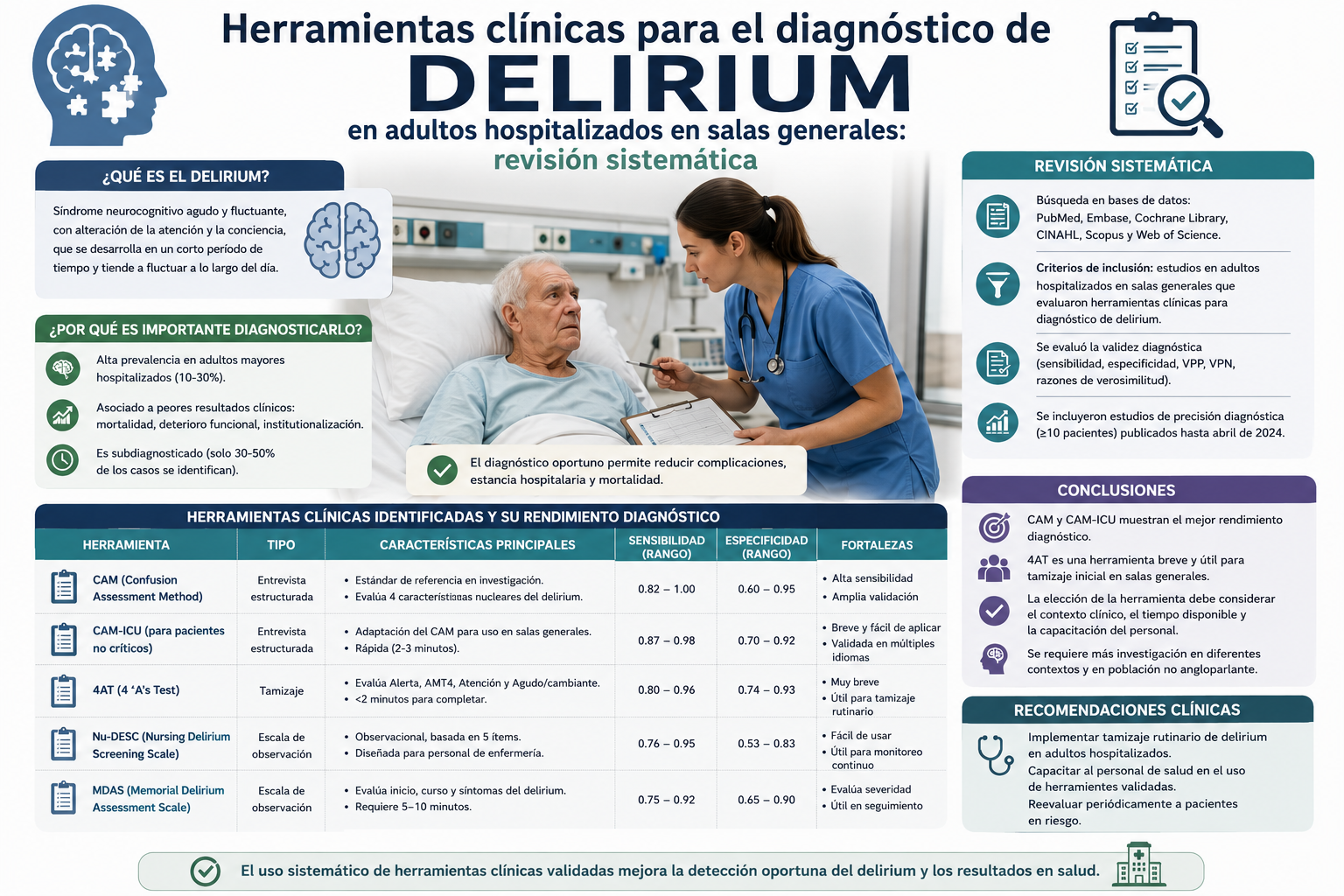
Delirium is an acute neuropsychiatric syndrome frequently observed in hospitalized patients and is associated with increased mortality, longer hospital stay, and functional decline. Despite its clinical importance, it remains underdiagnosed in general hospital wards. A systematic review was conducted following PRISMA recommendations and searches were performed in PubMed/MEDLINE, Scopus, Web of Science, and the Cochrane Library to identify studies evaluating clinical tools for delirium diagnosis in hospitalized adults. A total of 762 records were identified, and 29 studies met the inclusion criteria. The most commonly evaluated diagnostic tools were the Confusion Assessment Method (CAM), the 4AT, Nursing Delirium Screening Scale (Nu-DESC), and Delirium Rating Scale Revised-98 (DRS-R-98), all showing good diagnostic performance. Structured screening tools improve delirium detection in hospitalized adults. Instruments such as the CAM and the 4AT show good applicability and diagnostic performance in general hospital settings.
Downloads
References
American Psychiatric Association. (2013). Diagnostic and statistical manual of mental disorders (5th ed.). American Psychiatric Publishing. https://doi.org/10.1176/appi.books.9780890425596
Davis, D. H. J., Muniz-Terrera, G., Keage, H. A. D., Stephan, B. C. M., Fleming, J., Ince, P. G., et al. (2017). Association of delirium with cognitive decline in late life. JAMA Psychiatry, 74(3), 244–251. https://doi.org/10.1001/jamapsychiatry.2016.3423
Devlin, J. W., Skrobik, Y., Gélinas, C., Needham, D. M., Slooter, A. J. C., Pandharipande, P. P., et al. (2018). Clinical practice guidelines for the management of delirium. Critical Care Medicine, 46(9), e825–e873. https://doi.org/10.1097/CCM.0000000000003299
Ely EW, Inouye SK, Bernard GR, Gordon S, Francis J, May L, Truman B, Speroff T, Gautam S, Margolin R, Hart RP, Dittus R. (2001). Delirium in mechanically ventilated patients: validity and reliability of the confusion assessment method for the intensive care unit (CAM-ICU). JAMA. 2001 Dec 5;286(21):2703-10. doi: 10.1001/jama.286.21.2703. PMID: 11730446.
Fong, T. G., Tulebaev, S. R., & Inouye, S. K. (2009). Delirium in elderly adults: Diagnosis, prevention and treatment. Nature Reviews Neurology, 5(4), 210–220. https://doi.org/10.1038/nrneurol.2009.24
Gaudreau, J. D., Gagnon, P., Harel, F., Roy, M. A., & Tremblay, A. (2005). Fast, systematic and continuous delirium assessment in hospitalized patients: The Nursing Delirium Screening Scale. Journal of Pain and Symptom Management, 29(4), 368–375. https://doi.org/10.1016/j.jpainsymman.2004.07.009
Gusmao-Flores, D., Salluh, J. I. F., Chalhub, R. A., & Quarantini, L. C. (2012). The confusion assessment method for delirium diagnosis: Systematic review and meta-analysis. Critical Care, 16(4), R115. https://doi.org/10.1186/cc11407
Han, J. H., Wilson, A., & Ely, E. W. (2010). Delirium in the older emergency department patient. Emergency Medicine Clinics of North America, 28(3), 611–631. https://doi.org/10.1016/j.emc.2010.03.003
Inouye, S. K., Bogardus, S. T., Baker, D. I., Leo-Summers, L., & Cooney, L. M. (1999). The Hospital Elder Life Program: A model of care to prevent delirium. The New England Journal of Medicine, 340(9), 669–676. https://doi.org/10.1056/NEJM199903043400901
Inouye, S. K., van Dyck, C. H., Alessi, C. A., Balkin, S., Siegal, A. P., & Horwitz, R. I. (1990). Clarifying confusion: The Confusion Assessment Method. Annals of Internal Medicine, 113(12), 941–948. https://doi.org/10.7326/0003-4819-113-12-941
Inouye, S. K., Westendorp, R. G. J., & Saczynski, J. S. (2014). Delirium in elderly people. The Lancet, 383(9920), 911–922. https://doi.org/10.1016/S0140-6736(13)60688-1
Leslie, D. L., Marcantonio, E. R., Zhang, Y., Leo-Summers, L., & Inouye, S. K. (2008). One-year health care costs associated with delirium. Archives of Internal Medicine, 168(1), 27–32. https://doi.org/10.1001/archinternmed.2007.4
Maldonado, J. R. (2018). Delirium pathophysiology: An updated hypothesis. Psychosomatics, 59(3), 218–234. https://doi.org/10.1016/j.psym.2017.10.001
Marcantonio, E. R. (2017). Delirium in hospitalized older adults. The New England Journal of Medicine, 377(15), 1456–1466. https://doi.org/10.1056/NEJMcp1605501
Morandi, A., Davis, D., Taylor, J. K., et al. (2013). Consensus and variations in delirium detection tools. Journal of the American Geriatrics Society, 61(Suppl 2), S7–S12. https://doi.org/10.1111/jgs.12296
Neufeld, K. J., Leoutsakos, J. M., Sieber, F. E., Wanamaker, B. L., Gibson Chambers, J. J., Rao, V., et al. (2013). Evaluation of two delirium screening tools for postoperative delirium. Journal of the American Geriatrics Society, 61(1), 82–89. https://doi.org/10.1111/jgs.12097
Oh, E. S., Fong, T. G., Hshieh, T. T., & Inouye, S. K. (2017). Delirium in older persons: Advances in diagnosis and treatment. JAMA, 318(12), 1161–1174. https://doi.org/10.1001/jama.2017.12067
Page, M. J., McKenzie, J. E., Bossuyt, P. M., Boutron, I., Hoffmann, T. C., Mulrow, C. D., et al. (2021). The PRISMA 2020 statement: An updated guideline for reporting systematic reviews. BMJ, 372, n71. https://doi.org/10.1136/bmj.n71
Pendlebury, S. T., Lovett, N. G., Smith, S. C., Dutta, N., Bendon, C., Lloyd-Lavery, A., et al. (2015). Observational study of delirium in acute medical admissions. Age and Ageing, 44(5), 799–804. https://doi.org/10.1093/ageing/afv096
Ryan, D. J., O’Regan, N. A., Caoimh, R. Ó., Clare, J., O’Connor, M., Leonard, M., et al. (2013). Delirium in elderly hospital patients: Prevalence and outcomes. Age and Ageing, 42(4), 496–502. https://doi.org/10.1093/ageing/aft037
Saczynski, J. S., Marcantonio, E. R., Quach, L., Fong, T. G., Gross, A., Inouye, S. K., et al. (2012). Cognitive trajectories after postoperative delirium. The New England Journal of Medicine, 367(1), 30–39. https://doi.org/10.1056/NEJMoa1112923
Siddiqi, N., House, A. O., & Holmes, J. D. (2006). Occurrence and outcome of delirium in medical in-patients: A systematic literature review. Age and Ageing, 35(4), 350–364. https://doi.org/10.1093/ageing/afl005
Slooter, A. J. C., Otte, W. M., Devlin, J. W., Arora, R. C., Bleck, T. P., Claassen, J., et al. (2020). Updated nomenclature of delirium and acute encephalopathy. Intensive Care Medicine, 46, 1020–1022. https://doi.org/10.1007/s00134-019-05907-4
Tieges, Z., Maclullich, A. M. J., Anand, A., Brookes, C., Cassarino, M., O’Connor, M., et al. (2021). Diagnostic accuracy of the 4AT for delirium detection: Systematic review and meta-analysis. Age and Ageing, 50(3), 733–743. https://doi.org/10.1093/ageing/afaa224
Trzepacz, P. T., Mittal, D., Torres, R., Kanary, K., Norton, J., & Jimerson, N. (2001). Validation of the Delirium Rating Scale-Revised-98. The Journal of Neuropsychiatry and Clinical Neurosciences, 13(2), 229–242. https://doi.org/10.1176/jnp.13.2.229
van Velthuijsen, E. L., Zwakhalen, S. M. G., Warnier, R. M. J., Mulder, W. J., Verhey, F. R. J., & Kempen, G. I. J. M. (2016). Psychometric properties of delirium screening tools. International Journal of Geriatric Psychiatry, 31(9), 974–989. https://doi.org/10.1002/gps.4441
Wei, L. A., Fearing, M. A., Sternberg, E. J., & Inouye, S. K. (2008). The Confusion Assessment Method: A systematic review of current usage. Journal of the American Geriatrics Society, 56(5), 823–830. https://doi.org/10.1111/j.1532-5415.2008.01674.x
Witlox, J., Eurelings, L. S., de Jonghe, J. F., Kalisvaart, K. J., Eikelenboom, P., & van Gool, W. A. (2010). Delirium in elderly patients and the risk of post-discharge mortality, institutionalization and dementia: A meta-analysis. JAMA, 304(4), 443–451. https://doi.org/10.1001/jama.2010.1013
Wong, C. L., Holroyd-Leduc, J., Simel, D. L., & Straus, S. E. (2010). Does this patient have delirium? Value of bedside instruments. JAMA, 304(7), 779–786. https://doi.org/10.1001/jama.2010.1182
Published
How to Cite
Issue
Section
License
Copyright (c) 2026 Revista Científica Multidisciplinaria SAPIENTIAE. ISSN: 2600-6030.

This work is licensed under a Creative Commons Attribution-NonCommercial-ShareAlike 4.0 International License.


2.jpg)