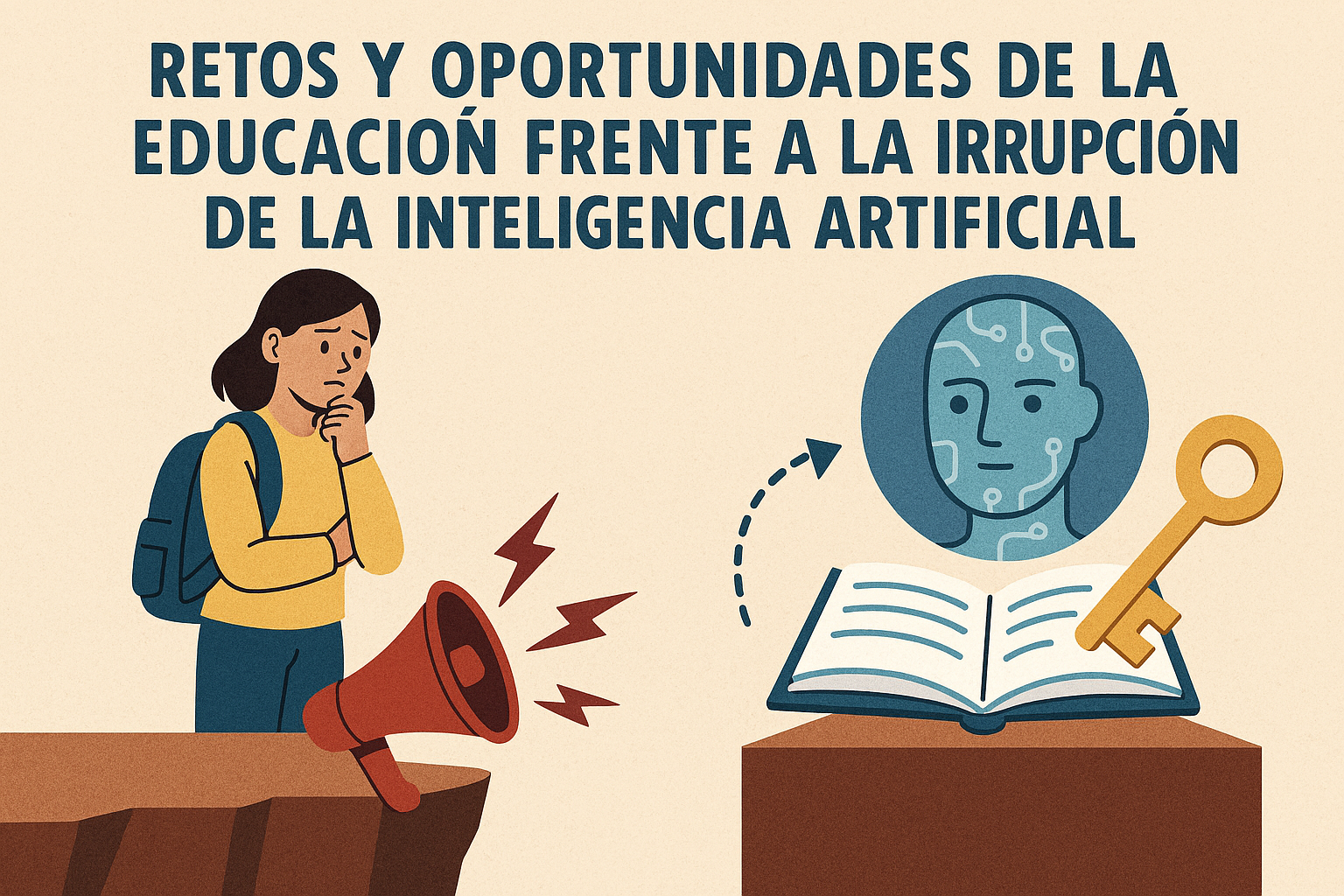
Retos y oportunidades de la educación frente a la irrupción de la inteligencia artificial
Keywords:
education; ethics; educational innovation; artificial intelligence; digital transformationAbstract
The dizzying advance of artificial intelligence (AI) is profoundly transforming educational scenarios, raising pedagogical, ethical and social questions that challenge traditional models of teaching and learning. The objective of this reflection essay is to analyze the main challenges and opportunities facing education in the face of the irruption of artificial intelligence, considering its impact on training processes, the role of the teacher and the development of competencies in students. The methodology used is based on a qualitative, reflective-analytical approach, based on the critical review of recent scientific literature and the argumentative analysis of current trends in education and artificial intelligence. The results show that, although AI introduces risks associated with technological dependence, the dehumanization of learning and digital divides, it also offers significant opportunities for educational personalization, pedagogical innovation and the strengthening of cognitive and metacognitive skills. It is concluded that the responsible and critical integration of artificial intelligence in education requires clear educational policies, continuous teacher training and an ethical vision that places the human being at the center of the educational process, thus guaranteeing a more inclusive, flexible and relevant education for the challenges of the twenty-first century.
Downloads
References
Abdulsalam-Nuhu, R. (2025). Qualitative study on integration of artificial intelligence technology in the classroom. Zijek Journal of Instructional Technology, 4(2), 134–151. https://doi.org/10.64348/zije.2025134
Alam, A., Alenezi, W. Y., & Faraasyatul’Alam, G. (2021). Possibilities and challenges of AI in education. International Journal of Educational Technology in Higher Education, 18(1), 1–18. https://doi.org/10.1186/s41239-021-00275-4
Bond, M., Buntins, K., Onditi, L., & Estrada, F. (2021). Artificial intelligence in education: Mapping the field. Computers & Education, 171, 104214. https://doi.org/10.1016/j.compedu.2020.104145
Celik, I., Moreno-Guerrero, A. J., & Ríos-Campos, C. (2023). Inteligencia artificial en educación: revisión sistemática de percepciones docentes. South American Review in Education, 7(4), 190–207. https://sa-rj.net/index.php/sarj/article/download/57/190/391
Chen, L., Chen, P., & Lin, Z. (2020). Artificial intelligence in education: A review. IEEE Access, 8, 75264–75278. https://doi.org/10.1109/ACCESS.2020.2988510
Cotton, D., Cotton, P., & Shipway, J. (2023). ChatGPT and assessment in higher education. Innovations in Education and Teaching International, 60(9), 973–983. https://doi.org/10.1080/14703297.2023.2185472
Garzón, J., Barrezueta, E. N. C., & Velásquez-Albarracín, V. P. (2025). Systematic Review of Artificial Intelligence in Education. Education Journal, 9(8), 84–102. https://www.mdpi.com/2414-4088/9/8/84
Holmes, W., Bialik, M., & Fadel, C. (2022). Ethics of AI in education. Computers & Education: Artificial Intelligence, 3, 100062. https://doi.org/10.1016/j.caeai.2022.100062
Kizilcec, R. F., & Lee, H. (2022). Algorithmic decision-making in education. Educational Researcher, 51(4), 242–256. https://doi.org/10.3102/0013189X221076394
Luckin, R., Holmes, W., Griffiths, M., & Forcier, L. B. (2022). AI and the future of teaching. British Journal of Educational Technology, 53(5), 1042–1055. https://doi.org/10.1111/bjet.13194
Matos, T., Velásquez-Albarracín, V. P., & Lucio-Ramos, Y. J. (2025). A systematic review of artificial intelligence applications in education. Expert Systems with Applications, 211, 124167. https://doi.org/10.1016/j.eswa.2024.124167
Merino-Campos, C. (2025). The impact of artificial intelligence on personalized learning. Journal of Personalized Learning Innovations, 4(2), 17–34. https://doi.org/10.3390/2813-4346/4/2/17
Ng, D. T. K., Fong, F. C. C., & Li, S. K. Y. (2021). AI literacy in education. Computers & Education: Artificial Intelligence, 2, 100028. https://doi.org/10.1016/j.caeai.2021.100028
Ortega, M. M. B. (2025). Desafíos y retos de la inteligencia artificial en la educación: propuestas para Ecuador. Educational Research and Development Journal, 12(1), 45–67. https://dialnet.unirioja.es/descarga/articulo/10343743.pdf
Parra-Sánchez, J. S. (2025). Teachers’ perspectives on AI in education: Benefits and perceived challenges. South American Review in Education, 7(4), 57–76. https://sa-rj.net/index.php/sarj/article/view/57
Pedro, F., & Siemens, G. (2019). Artificial intelligence in education: Challenges and opportunities. OECD Education Working Papers, 210, 1–33. https://doi.org/10.1787/f770d3ed-en
Siemens, G., & Baker, R. S. J. d. (2021). Learning analytics and educational data mining. British Journal of Educational Technology, 52(4), 454–472. https://doi.org/10.1111/bjet.13024
Slade, S., & Prinsloo, P. (2023). Ethical challenges of learning analytics. Distance Education, 44(1), 112–121. https://doi.org/10.1080/01587919.2023.2182136
UNESCO. (2025). Artificial Intelligence in Education. UNESCO Digital Education Report. https://www.unesco.org/en/digital-education/artificial-intelligence
Vieriu, A. M., & Petrea, G. (2025). The impact of artificial intelligence (AI) on students’ learning processes and academic performance. Journal of Educational Technology Studies, 15(3), 343–359. https://doi.org/10.3390/22277102/15/3/343
Wang, S., Wang, F., Zhu, Z., Wang, J., Tran, T., & Du, Z. (2024). Artificial intelligence in education: A systematic literature review. Expert Systems with Applications, 211, 124167. https://doi.org/10.1016/j.eswa.2024.124167
Williamson, B., & Eynon, R. (2020). Historical perspectives on AI in education. Learning, Media and Technology, 45(1), 1–12. https://doi.org/10.1080/17439884.2020.1790542
Published
How to Cite
Issue
Section
License
Copyright (c) 2026 Revista Científica Multidisciplinaria SAPIENTIAE. ISSN: 2600-6030.

This work is licensed under a Creative Commons Attribution-NonCommercial-ShareAlike 4.0 International License.


2.jpg)