Presentismo laboral y consecuencias negativas en la salud mental
DOI:
https://doi.org/10.56124/sapientiae.v9i20.010Keywords:
Workplace presenteeism, mental health, psychosocial risks, occupational medicine, productivity, workplace well-beingAbstract
ABSTRACT
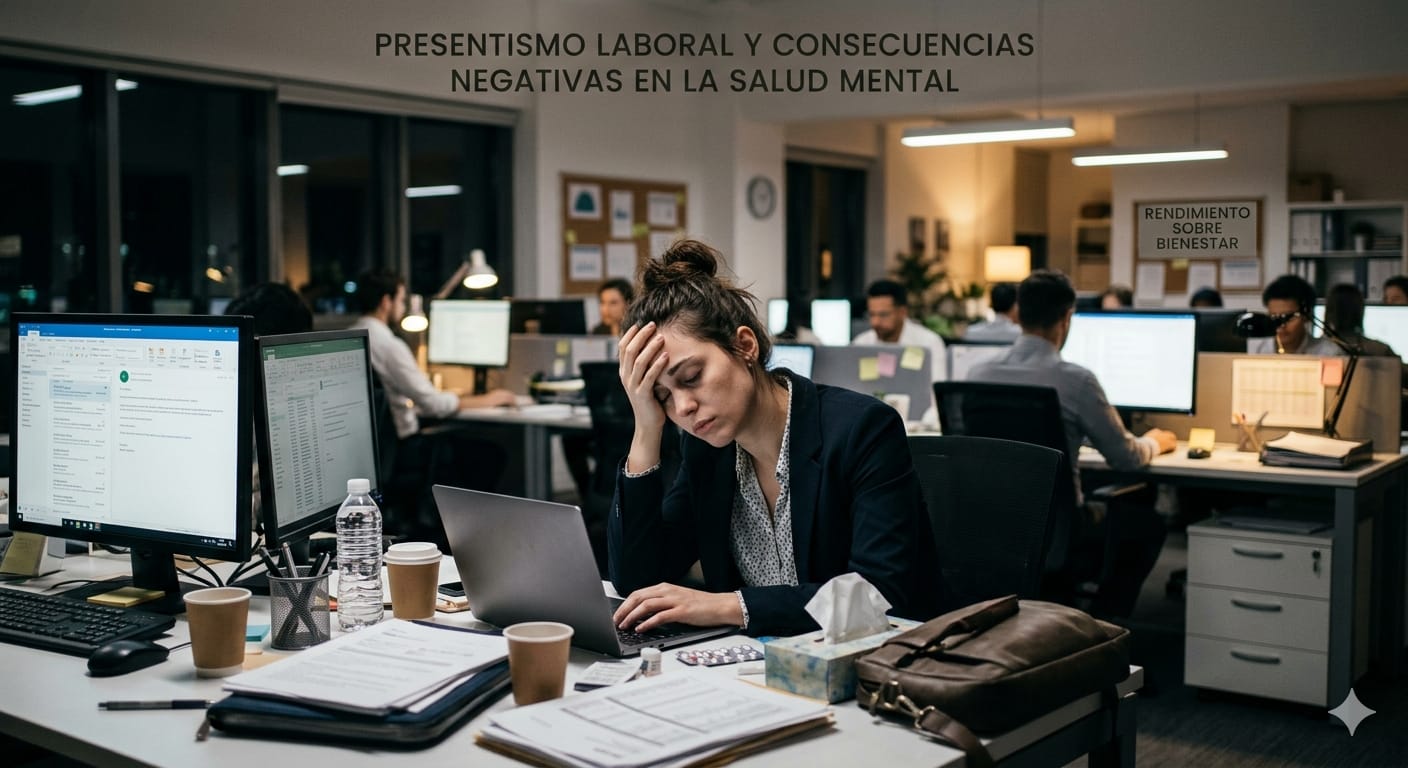
This study analyzed presenteeism, understood as the behavior of attending work despite having health problems, which can negatively affect psychosocial well-being. The objective was to synthesize the available evidence on its repercussions on mental health, as well as to identify the associated risk factors and the most affected occupations. The methodology consisted of a documentary review of research published between 2005 and 2025, consulted in international scientific databases. The findings show that presenteeism is associated with depression, anxiety, emotional exhaustion, and an increased risk of prolonged absences. In addition, a high prevalence was observed in health professionals, teachers, and workers exposed to high workloads or contractual instability. It is concluded that presenteeism constitutes a relevant psychosocial risk and that Occupational Medicine plays a key role in its prevention and monitoring.
Downloads
References
Allan, B. A., Autin, K. L., & Wilkins-Yel, K. G. (2021). Precarious work in the 21st century: A psychological perspective. Journal of Vocational Behavior, 126, 103491. https://doi.org/10.1016/j.jvb.2020.103491
Alonso, G. S., & Tarazona, Á. A. (2022). Presentismo e historia del tiempo presente: elementos para una discusión actual del quehacer historiográfico. Trashumante. Revista Americana de Historia Social, (19), 208-230. https://www.redalyc.org/articulo.oa?id=455670658010
Arroyave, E. A., Martínez, V. O., Medrano, R. M. T., Molano, C. E. R., & Aljure, L. R. B. (2023). Validación de la STANFORD PRESENTEEISM SCALE-SPS 6 para instituciones del sector salud en Colombia. Revista Colombiana de Salud Ocupacional, 13(1), 1-7. https://www.redalyc.org/journal/7337/733776334003/733776334003.pdf
Aronsson, G., Gustafsson, K., & Dallner, M. (2000). Sick but yet at work. An empirical study of sickness presenteeism. Journal of Epidemiology & Community Health, 54(7), 502-509. https://jech.bmj.com/content/54/7/502.short
Bergström, G., Bodin, L., Hagberg, J., Aronsson, G., & Josephson, M. (2009). Sickness presenteeism today, sickness absenteeism tomorrow? A prospective study on sickness presenteeism and future sickness absenteeism. Journal of occupational and environmental medicine, 51(6), 629-638.
Dew, K., Vera, K., & Small, K. (2005). 'Elegir' trabajar estando enfermo: presentismo laboral. Science Direct. 60(10):2273-2282. https://www.sciencedirect.com/science/article/abs/pii/S0277953604005271?
López Rozo, E. M., & Riaño Casallas, M. I. (2015). Presentismo y su relación con la seguridad y salud en el trabajo: una revisión de la literatura. Movimiento Científico. 9(1): 50-59 https://revmovimientocientifico.ibero.edu.co/article/view/856?
Goetzel RZ, Long SR, Ozminkowski RJ, Hawkins K, Wang S, Lynch W. Health, absence, disability, and presenteeism cost estimates of certain physical and mental health conditions affecting U.S. employers. J Occup Environ Med. 2004 Apr;46(4):398-412. doi: 10.1097/01.jom.0000121151.40413.bd. PMID: 15076658.
Halbesleben, J. R. (2021). Individual-level outcomes of employee engagement: a conservation of resources framework. In A research agenda for employee engagement in a changing world of work (pp. 87-100). Edward Elgar Publishing. https://www.elgaronline.com/edcollchap/edcoll/9781789907841/9781789907841.00013.xml
Hyoungseob, Y., Song, J.-H., & Hyoung, K. (2022). Association between presenteeism and mental health among logistic center workers. The Annals of Occupational and Environmental Medicine (AOEM). Obtenido de https://doi.org/10.35371/aoem.2022.34.e39
Kişi, N. (2025). Analysis of presenteeism using a science mapping approach. Current Psychology, 44(10), 8648-8663. https://doi.org/10.1007/s12144-025-07857-1
Luján, G. D. C. S., Arrieta, E. D., & Medina, R. T. (2023). Monetización de los Costos por Perdida de Productividad Relacionada con el Presentismo por Enfermedad. Revista de Gestión Empresarial y Sustentabilidad, 8(1), 106-122.
Kinman, G. (2019). Sickness presenteeism at work: prevalence, costs and management. British medical bulletin, 129(1), 69-78. https://academic.oup.com/bmb/article-abstract/129/1/69/5288253?redirectedFrom=PDF
Lazo Páez, A., & Roldán Abellán, B. (2015). Implicaciones del presentismo en la productividad laboral del área de la salud. Medicina Legal de Costa Rica, 32(1), 146-153. https://www.scielo.sa.cr/scielo.php?script=sci_arttext&pid=S1409-00152015000100018
Letvak, S. A., Ruhm, C. J., & Gupta, S. N. (2012). Nurses' presenteeism and its effects on self-reported quality of care and costs. AJN The American Journal of Nursing, 112(2), 30-38. https://journals.lww.com/ajnonline/fulltext/2012/02000/original_research__nurses__presenteeism_and_its.21.aspx
Lohaus, D., & Habermann, W. (2019). Presenteeism: A review and research directions. Human Resource Management Review, 29(1), 43-58. https://www.sciencedirect.com/science/article/abs/pii/S105348221830127X?utm
Miraglia, M., & Johns, G. (2016). Going to work ill: A meta-analysis of the correlates of presenteeism and a dual-path model. Journal of occupational health psychology, 21(3), 261. https://psycnet.apa.org/record/2015-51045-001
Pauly, M. V., Nicholson, S., Polsky, D., Berger, M. L., & Sharda, C. (2008). Valuing reductions in on‐the‐job illness:‘presenteeism’from managerial and economic perspectives. Health economics, 17(4), 469-485. https://onlinelibrary.wiley.com/doi/abs/10.1002/hec.1266
Revuelta, J. F. R. (2014). Presentismo en Enfermería. Implicaciones en seguridad del paciente. Posibilidades de control y reducción. Enfermería Global, 13(3), 362-383. https://scielo.isciii.es/scielo.php?script=sci_arttext&pid=S1695-61412014000300020&lng=es&nrm=iso
Salvagioni, D. A. J., Melanda, F. N., Mesas, A. E., González, A. D., Gabani, F. L., & De Andrade, S. M. (2017). Physical, psychological and occupational consequences of job burnout: A systematic review of prospective studies. PloS one, 12(10), e0185781. https://journals.plos.org/plosone/article?id=10.1371/journal.pone.0185781&utm
Ruhle, S. A., & Breitsohl, H. (2023). Perceived legitimacies of health‐related and motivational presenteeism and absenteeism: Development and validation of the Workplace Attendance Behavior Legitimacy Scale. Journal of Organizational Behavior, 44(6), 973-996. https://onlinelibrary.wiley.com/doi/full/10.1002/job.2675
Sánchez-Zaballos, M., Baldonedo-Mosteiro, M., & Mosteiro-Díaz, M. P. (2018). Presentismo en profesionales sanitarios de los servicios de urgencias y emergencias. Emergencias, 30(1). https://dialnet.unirioja.es/servlet/articulo?codigo=6241342
Schnabel, C. (2022). Presenteeism at the workplace . IZA World of Labor, 1-8. https://wol.iza.org/articles/presenteeism-at-the-workplace/long
Suzuki, T., Miyaki, K., Song, Y., Tsutsumi, A., Kawakami, N., Shimazu, A., ... & Kurioka, S. (2015). Relationship between sickness presenteeism (WHO–HPQ) with depression and sickness absence due to mental disease in a cohort of Japanese workers. Journal of affective disorders, 180, 14-20. https://linkinghub.elsevier.com/retrieve/pii/S0165032715001731
Taloyan, M., Aronsson, G., Leineweber, C., Magnusson Hanson, L., Alexanderson, K., & Westerlund, H. (2012). Sickness presenteeism predicts suboptimal self-rated health and sickness absence: a nationally representative study of the Swedish working population. https://journals.plos.org/plosone/article?id=10.1371/journal.pone.0044721
Vera, A., Carrasco, C., Da Costa, S., & Páez, D. (2015). Factores psicosociales del presentismo en trabajadores del Sistema de Salud chileno. Scielo. Obtenido de https://scielo.isciii.es/scielo.php?pid=S1576-59622015000200007&script=sci_arttext&utm
Vera-Calzaretta, A., Carrasco-Dájer, C., Costa, S. D., & Páez-Rovira, D. (2015). Factores psicosociales del presentismo en trabajadores del Sistema de Salud chileno. Revista de Psicología del Trabajo y de las Organizaciones, 31(2), 119-128. https://scielo.isciii.es/pdf/rpto/v31n2/v31n2a07.pdf
Väänänen, A., Tordera, N., Kivimäki, M., Kouvonen, A., Pentti, J., Linna, A., & Vahtera, J. (2008). The role of work group in individual sickness absence behavior. Journal of health and social behavior, 49(4), 452-467. https://journals.sagepub.com/doi/abs/10.1177/002214650804900406
Väänänen, R. K. (2008). Work–Family Characteristics as Determinants of Sickness Absence: A Large-Scale Cohort Study of Three Occupational Grades. Journal of Occupational Health Psychology, 181-196. https://psycnet.apa.org/fulltext/2008-03497-008.html
Wang, J., Schmitz, N., Smailes, E., Sareen, J., & Patten, S. (2010). Workplace characteristics, depression, and health-related presenteeism in a general population sample. Journal of occupational and environmental medicine, 52(8), 836-842. https://journals.lww.com/joem/abstract/2010/08000/workplace_characteristics,_depression,_and.10.aspx
Widera, E., Chang, A., & Chen, H. L. (2010). Presenteeism: a public health hazard. Journal of general internal medicine, 25(11), 1244-1247. https://link.springer.com/article/10.1007/s11606-010-1422-x
Published
How to Cite
Issue
Section
License
Copyright (c) 2026 Revista Científica Multidisciplinaria SAPIENTIAE. ISSN: 2600-6030.

This work is licensed under a Creative Commons Attribution-NonCommercial-ShareAlike 4.0 International License.


2.jpg)