Uso de tecnología contable y cumplimiento del régimen simplificado en la Asociación de Comerciantes minoristas de jipijapa
DOI:
https://doi.org/10.56124/sapientiae.v9i19.019Keywords:
Accounting technology, simplified regime, tax compliance, merchants, digitalization.Abstract
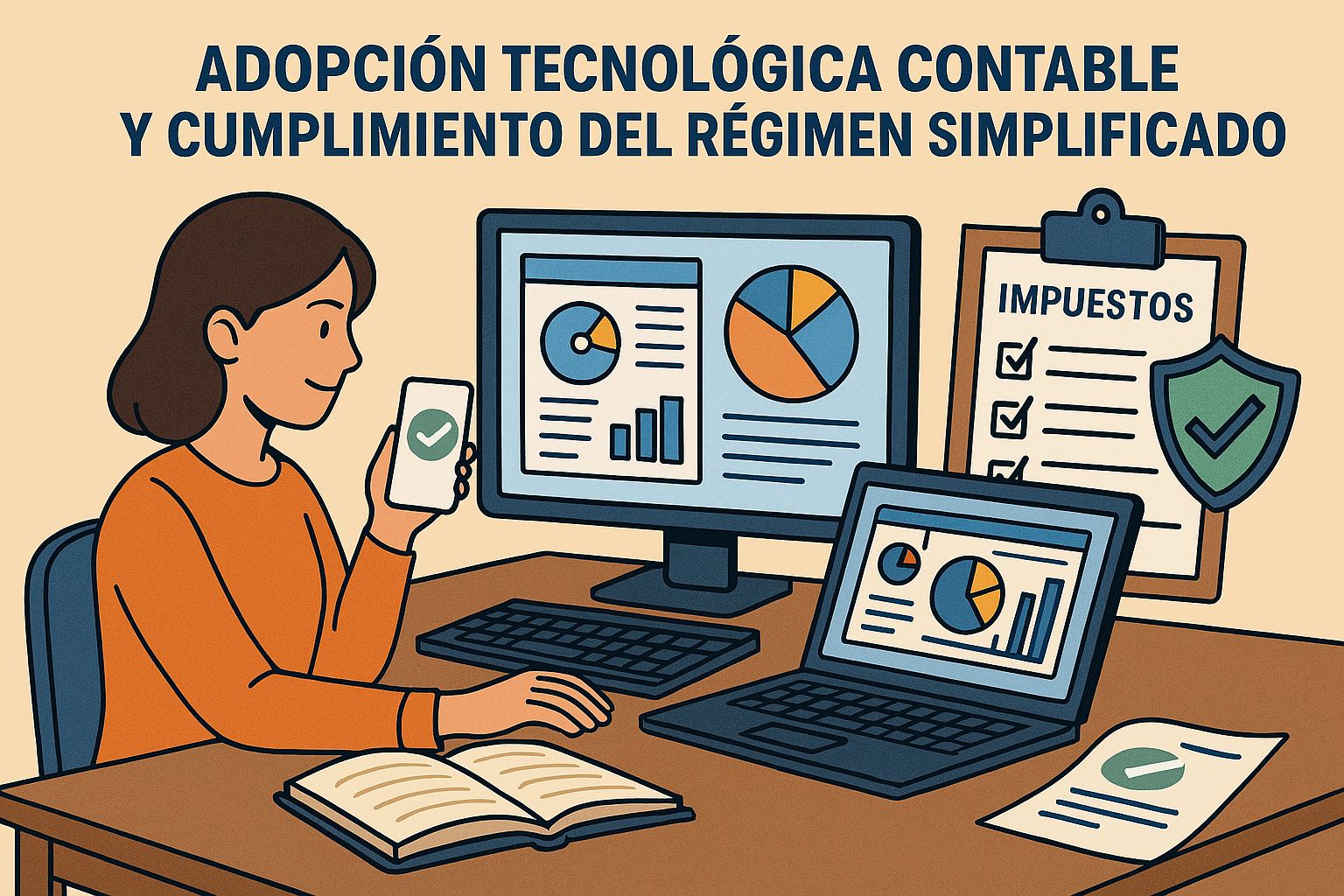
The tax management of small taxpayers is going through a process of transition to digital environments, which poses important challenges for sectors with low technological literacy. In this context, the Association of Retail Merchants of Jipijapa presents limitations in the use of digital accounting tools, a situation that affects the organization of records and compliance with the simplified regime. The general objective of the study was to analyze the relationship between the use of accounting technology and the level of compliance with the simplified regime by the associated merchants. A mixed methodology was used based on a survey applied through a questionnaire to the 69 members and an interview addressed to the president of the Association. This combination made it possible to understand both technological practices and the perceptions and difficulties of merchants. The results show an irregular use of digital platforms, limited to basic functions, which affects income control, the correct issuance of receipts and the document organization required by the SRI. Although some merchants recognize a certain benefit, a partial management that reduces tax efficiency prevails. It is concluded that insufficient training, functional ignorance and low technological appropriation hinder tax compliance, so it is necessary to strengthen digital training and technical support within the Association.
Downloads
References
Arias, I. P., De la A, S. E., López, A. L., & Izurieta, C. W. (2023).
El régimen de tributación RIMPE en el Ecuador. Polo del Conocimiento, 8(6), 902–919.
https://polodelconocimiento.com/ojs/index.php/es/article/view/4885
Bellon, M., Dabla-Norris, E., Khalid, S., & Lima, F. (2022).
Digitalización para mejorar el cumplimiento tributario: Evidencia de la Facturación Electrónica del IVA en Perú. Journal of Public Economics, 104661. https://doi.org/10.1016/j.jpubeco.2022.104661
Bravo, G. J., Mendoza, V. B., & Mera, C. (2022). Recaudación tributaria del cantón Montecristi por el Régimen Impositivo Simplificado. Dominio de las Ciencias, 8(3), 102–116.
https://dominiodelasciencias.com/ojs/index.php/es/article/view/2739
Creswell, J. W., & Plano Clark, V. L. (2018). Designing and conducting mixed methods research (3rd ed.). SAGE.
https://us.sagepub.com/en-us/nam/designing-and-conducting-mixed-methods-research/book241842
Coello, J. R. (2022). El régimen impositivo ecuatoriano y su incidencia en el cumplimiento de las obligaciones tributarias de la empresa del señor Arturo Clavijo durante el periodo 2021 [Tesis de grado, Universidad Técnica de Babahoyo].
http://dspace.utb.edu.ec/handle/49000/12757
Escobar, J., & Cuervo, A. (2008). Validez de contenido y juicio de expertos. Avances en Medición, 6, 27–36. https://revistas.udistrital.edu.co/index.php/avances/article/view/2269
Hernández, R., Fernández, C., & Baptista, P. (2014). Metodología de la investigación (6.ª ed.). McGraw-Hill. https://www.mheducation.com.mx/metodologia-de-la-investigacion-6ed.html
Lescano, P. E. (2021). El Régimen Impositivo Simplificado en el Ecuador y su incidencia en la evasión tributaria [Tesis de grado, Universidad Técnica de Ambato]. https://repositorio.uta.edu.ec/handle/123456789/32336
Manabú, N. d., & Mengistu, A. (2023). Exploración de la adopción de tecnologías digitales seleccionadas en la administración tributaria: una perspectiva transnacional. Fondo Monetario Internacional.
https://doi.org/10.5089/9798400258183.068
Mayea, R. I. (2024). Cambio de Régimen Impositivo Simplificado a Régimen Simplificado para Emprendedores y Negocios Populares del Ecuador [Tesis de grado, Universidad Tecnológica Empresarial de Guayaquil].
http://biblioteca.uteg.edu.ec/xmlui/handle/123456789/2640
Narváez, P. E. (2021). Las tecnologías de la información y comunicación orientadas a la calidad del servicio en la gestión empresarial: una revisión sistemática [Tesis de grado, Universidad Politécnica Salesiana].
https://dspace.ups.edu.ec/handle/123456789/20929
Neira, M. J. (2022). Aplicación del régimen impositivo simplificado ecuatoriano (RISE) y su incidencia económica del sector informal de Machala periodo 2021 [Tesis de grado, Universidad Técnica de Machala].
http://repositorio.utmachala.edu.ec/handle/48000/19541
Ocampo, A. M. (2023). Efectos de la transformación digital en el sector contable y financiero en Ecuador. Ciencia y Educación, 4(11), 42–52.
https://doi.org/10.5281/zenodo.10212374
Ribeiro, J., & Lopes, T. (2022). Inteligencia artificial: Tecnologías emergentes y aplicaciones empresariales. Applied Artificial Intelligence, 36(4), 321–340.
https://doi.org/10.1080/08839514.2022.2047756
Tashakkori, A., & Teddlie, C. (2010). Mixed methodology: Combining qualitative and quantitative approaches. SAGE.
https://methods.sagepub.com/book/mixed-methodology
Torres, L., & Mendoza, H. (2021). Factores que afectan la adopción de tecnologías digitales en las MIPYMES. Economía y Desarrollo, 63(3), 98–112.
Published
How to Cite
Issue
Section
License
Copyright (c) 2025 Revista Científica Multidisciplinaria SAPIENTIAE. ISSN: 2600-6030.

This work is licensed under a Creative Commons Attribution-NonCommercial-ShareAlike 4.0 International License.


2.jpg)