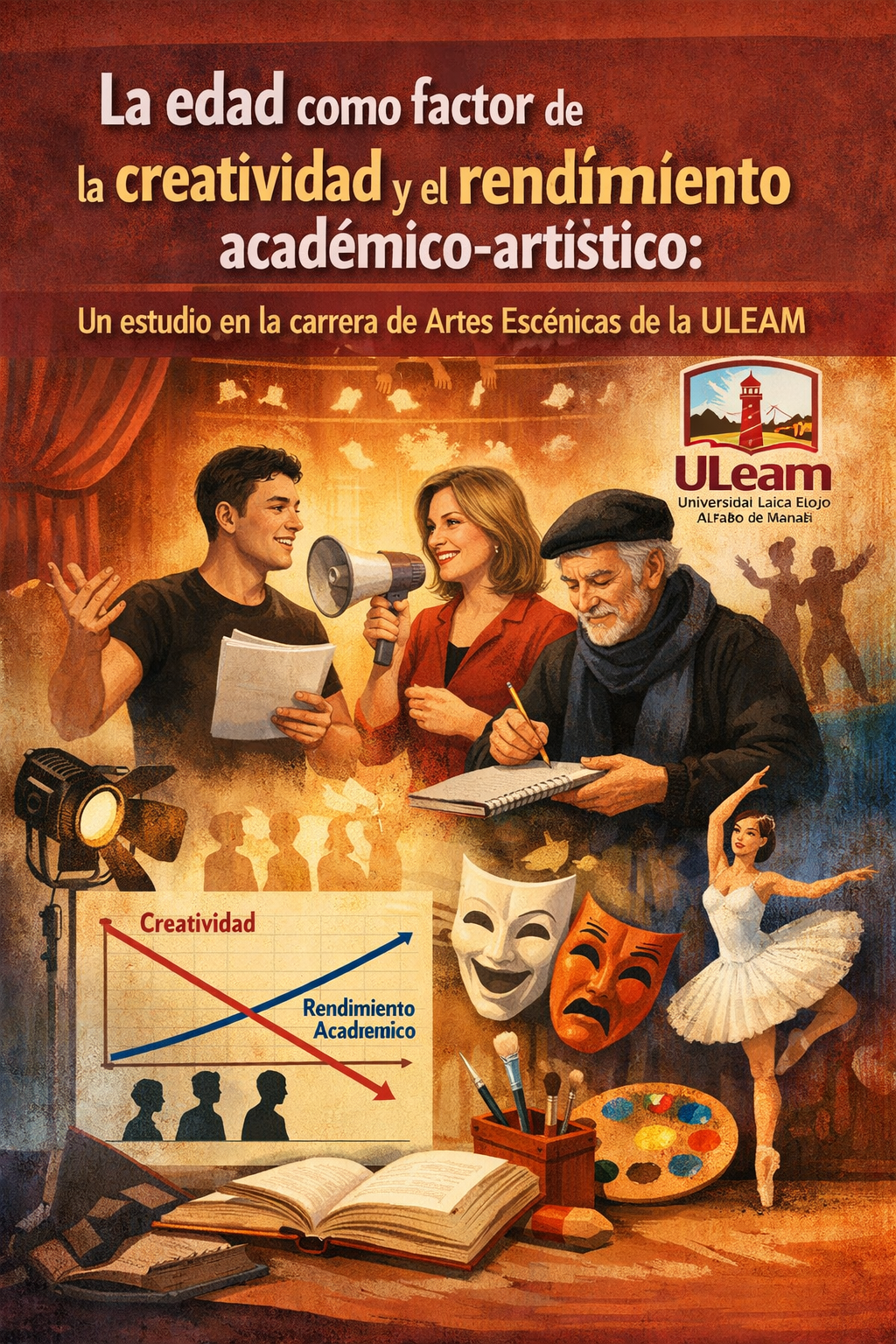
La edad como factor de la cretividad y el rendimiento académico- artístico: Un estudio en la carrera de Artes Escénicas de la ULEAM
DOI:
https://doi.org/10.56124/sapientiae.v9i19.024Keywords:
Keywords: creativity, age, academic performance, performing arts, higher education.Abstract
This study aimed to analyze the relationship between age, creativity, and academic-artistic performance in students of the Performing Arts program at the Eloy Alfaro Lay University of Manabí (ULEAM). Using a quantitative, correlational design, 136 students participated, distributed across three age groups: 18–22, 23–29, and 30 years and older. The Torrance Tests of Creative Thinking were administered to measure creativity, and academic records and evaluations of performing arts projects were collected to observe academic-artistic performance. The results showed that creativity manifests itself in diverse ways depending on age. Younger students scored higher in fluency and flexibility (qualities associated with a more exploratory type of thinking). Older students, however, obtained better results in originality and elaboration. Regarding academic performance, younger students scored higher in theoretical subjects, while older students obtained higher grades for artistic projects (which promote divergent thinking). Pearson's correlation showed positive relationships between age and originality, as well as between two variables: overall creativity and student performance in performing arts projects. However, age was not found to be a significant predictor of overall academic performance.In conclusion, creativity does not diminish with age, but rather transforms, contributing different strengths at each stage of life. These findings reinforce the importance of promoting inclusive learning environments that recognize age diversity as a resource for enriching performing arts education.
Keywords: creativity, age, academic performance, performing arts, higher education.
Downloads
References
Akpur, U. (2020). Critical, reflective, creative thinking and their reflections on academic achievement. Thinking Skills and Creativity, 37, 100683. https://doi.org/10.1016/j.tsc.2020.100683 (semanticscholar.org)
Amabile, T. M. (2018). Creativity in context: Update to the social psychology of creativity. Routledge.
Beaty, R. E., Benedek, M., Kaufman, S. B., & Silvia, P. J. (2015). Default and executive network coupling supports creative idea production. Scientific Reports, 5(1), 10964. https://doi.org/10.1038/srep10964
Beaty, R. E., Seli, P., & Schacter, D. L. (2020). Network neuroscience of creative cognition: Mapping cognitive mechanisms and individual differences in the creative brain. Current Opinion in Behavioral Sciences, 27, 22–30. https://doi.org/10.1016/j.cobeha.2018.08.013
Beghetto, R. A. (2021). Creative learning: A fresh look. Routledge.
Bisquerra, R. (2019). Metodología de la investigación educativa (5.ª ed.). La Muralla.
Carranza, M. (2021). Pensamiento creativo: un estudio holístico en la educación. Revista Innova Educación, 3(4), 123–132. https://doi.org/10.35622/j.rie.2021.04.009.es
Cuetos Revuelta, M. J., Grijalbo Fernández, L., Argüeso Vaca, E., Escamilla Gómez, V., & Ballesteros Gómez, R. (2020). Potencialidades de las TIC y su papel fomentando la creatividad: Percepciones del profesorado. RIED. Revista Iberoamericana de Educación a Distancia, 23(2), 287–306. https://doi.org/10.5944/ried.23.2.26247 (revistas.uned.es)
Dogan, N., Manassero, M., & Vázquez, Á. (2020). El pensamiento creativo en estudiantes para profesores de ciencias: Efectos del aprendizaje basado en problemas y en la historia de la ciencia. Tecné, Episteme y Didaxis: TED, 48, 163–180. https://doi.org/10.17227/ted.num48-10926 (revistainnovaeducacion.com)
Freiberg-Hoffmann, A., Berenguer, C., & Fernández-Liporace, M. (2021). Creatividad y enfoques de aprendizaje en estudiantes universitarios. Psicología desde el Caribe, 38(2), 106–127. https://doi.org/10.17081/psico.24.46.4492 (SciELO)
Gu, X., Ritter, S. M., & Dijksterhuis, A. (2019). Fostering children’s creative thinking skills with the 5-I training program. Thinking Skills and Creativity, 32, 92–101. https://doi.org/10.1016/j.tsc.2019.05.002 (ResearchGate)
Hennessey, B. A., & Amabile, T. M. (2019). Creativity. Annual Review of Psychology, 71, 569–598. 10.1146/annurev.psych.093008.100416
Hernández-Sampieri, R., & Mendoza, C. (2018). Metodología de la investigación: Las rutas cuantitativa, cualitativa y mixta. McGraw-Hill Interamericana.
Kaufman, J. C., & Glăveanu, V. P. (2019). A review of creativity theories: What questions are we trying to answer? Creativity Research Journal, 31(4), 377–386. 10.1017/9781316979839.004
Kim, K. H. (2006). Can we trust creativity tests? A review of the Torrance Tests of Creative Thinking. Creativity Research Journal, 18(1), 3–14.
https://doi.org/10.1207/s15326934crj1801_2
Rodríguez, A., & Hernández, M. (2020). Género y rendimiento académico en carreras artísticas: Un análisis en educación superior. Revista Iberoamericana de Educación Superior, 11(31), 85–103.
Rodríguez, M. I. J. (2024). Análisis de las estrategias empleadas en educación artística para fomentar el pensamiento creativo. Scientific, 9(33), 341–360. https://doi.org/10.29394/Scientific.issn.2542-2987.2024.9.33.16.341-360 (indteca.com)
Sánchez-López, I., Bonilla-del-Río, M., & Soares, I. O. (2021). Creatividad digital para transformar el aprendizaje: Empoderamiento desde un enfoque com-educativo. Comunicar, 29(69), 113–123. https://doi.org/10.3916/C69-2021-09 (revistacomunicar.com)
Sawyer, R. K. (2018). The Cambridge handbook of creativity (2nd ed.). Cambridge University Press.
Sigüenza Orellana, J. P., & Guevara Vizcaíno, C. F. (2022). El arte como innovación educativa para desarrollar el pensamiento en el siglo XXI. Revista Científica UISRAEL, 9(3), 131–148. https://doi.org/10.35290/rcui.v9n3.2022.597 (SciELO)
Simonton, D. K. (2000). Creativity: Cognitive, personal, developmental, and social aspects. American Psychologist, 55(1), 151–158.
https://doi.org/10.1037/0003-066X.55.1.151
Sio, U. N., Kotys-Schwartz, D., & Lortie-Forgues, H. (2024). The impact of creativity training on creative performance: A meta-analytic review and critical evaluation of 5 decades of creativity training studies. Psychological Bulletin, 150(5), 554–585. https://doi.org/10.1037/bul0000432 (PubMed)
Published
How to Cite
Issue
Section
License
Copyright (c) 2026 Revista Científica Multidisciplinaria SAPIENTIAE. ISSN: 2600-6030.

This work is licensed under a Creative Commons Attribution-NonCommercial-ShareAlike 4.0 International License.

2.jpg)