Pensamiento crítico y currículo del bachillerato: implicaciones pedagógicas para la formación universitaria inicial
DOI:
https://doi.org/10.56124/sapientiae.v9i20.001Resumen
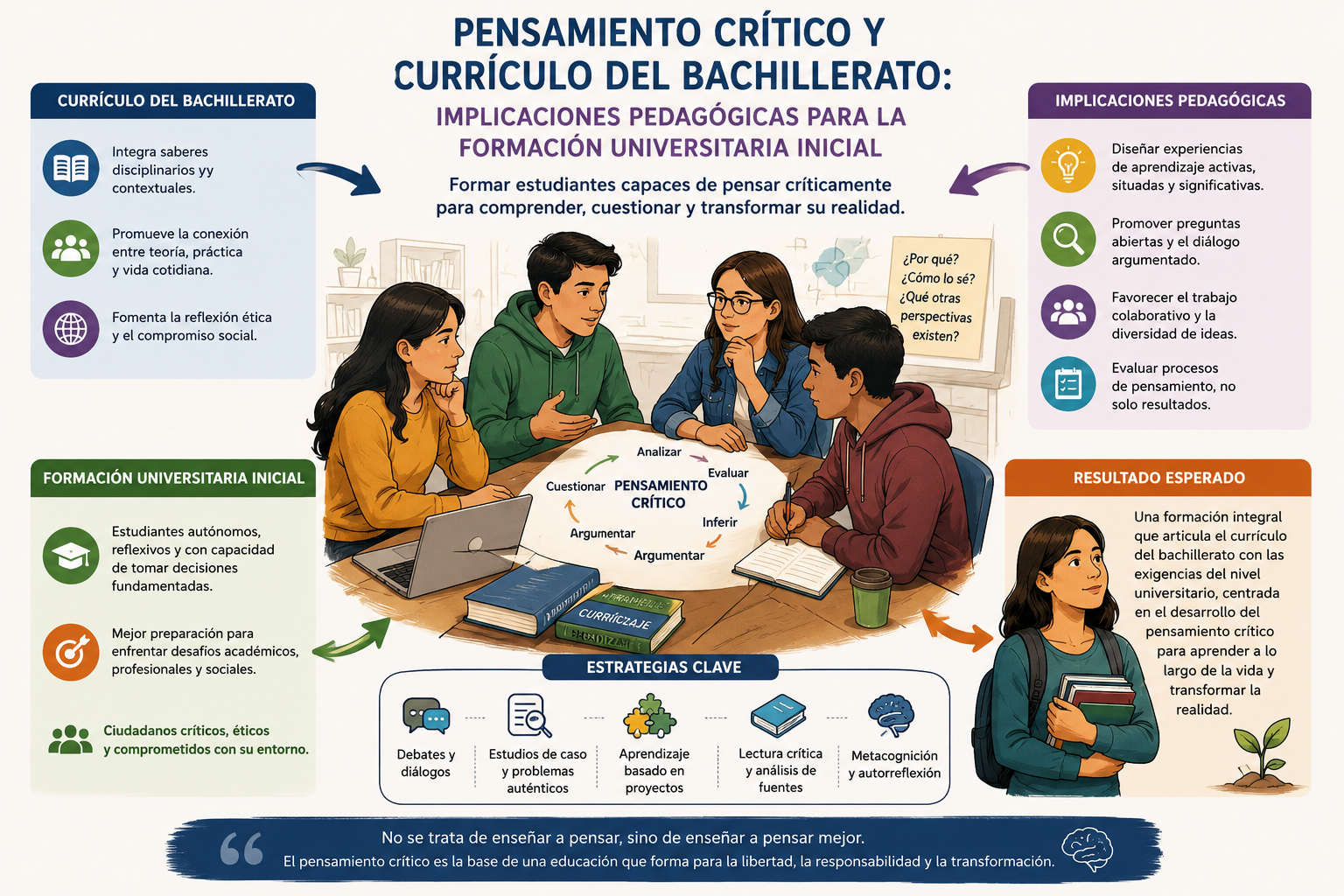
El desarrollo del pensamiento crítico es una condición fundamental para el desempeño académico en la educación superior y para la participación informada en contextos sociales complejos. Sin embargo, en América Latina quedan evidencias indicativas de un número significativo de estudiantes que termina el bachillerato sin alcanzar niveles satisfactorios en comprensión lectora, razonamiento analítico y argumentativo, lo cual incide directamente en su transición hacia la universidad. Este estudio analiza la relación entre el diseño curricular del bachillerato y el desarrollo del pensamiento crítico y sus efectos en la formación universitaria inicial, con referencia al contexto latinoamericano y al caso ecuatoriano. Se apoyó en un enfoque cualitativo mediante análisis documental de carácter analítico-interpretativo, con fundamento en literatura pedagógica especializada, informes de organismos internacionales y documentos institucionales nacionales. Los hallazgos muestran que la persistencia de modelos curriculares centrados en la transmisión de contenidos y en prácticas evaluativas orientadas a la reproducción obstruye la consolidación de habilidades cognitivas de orden superior. Como resultado, se generan brechas formativas que se proyectan hacia la educación superior, donde las instituciones implementan procesos de nivelación para atender carencias acumuladas. En conclusión, el fortalecimiento del pensamiento crítico amerita una revisión estructural del currículo de dicho nivel y una articulación efectiva entre los distintos niveles del sistema educativo, a fin de asegurar coherencia en la trayectoria formativa del estudiantado.
Descargas
Citas
Abrami, P. C., Bernard, R. M., Borokhovski, E., Waddington, D. I., Wade, C. A., & Persson, T. (2018). Strategies for teaching students to think critically: A meta-analysis. Review of Educational Research, 88(2), 275–314. https://doi.org/10.3102/0034654317752087
Amani, J., & Mkimbili, S. T. (2025). Developing critical thinking skills among secondary school students: The role of project-based learning. Thinking Skills and Creativity, 58, 101883. https://doi.org/10.1016/j.tsc.2025.101883
Andreucci-Annunziata, P., Morales-Salinas, L., Cortés-Maturana, H., & González-Fernández, M. O. (2023). Conceptualizations and instructional strategies on critical thinking in higher education: A systematic review of reviews. Frontiers in Education, 8, 1141686. https://doi.org/10.3389/feduc.2023.1141686
Anggraeni, D. M., Prahani, B. K., Suprapto, N., Shofiyah, N., & Jatmiko, B. (2023). A systematic review of problem-based learning research in fostering critical thinking skills. Thinking Skills and Creativity, 49, 101334. https://doi.org/10.1016/j.tsc.2023.101334
Arias Ortiz, E., Dueñas, X., Giambruno, C., & López, A. (2024). El estado de la educación en América Latina y el Caribe 2024: La medición de los aprendizajes. Banco Interamericano de Desarrollo.
Banco Mundial. (2019). Ending learning poverty: What will it take? Washington, DC: World Bank.
Bengtsson, M. (2016). How to plan and perform a qualitative study using content analysis. NursingPlus Open, 2, 8–14. https://doi.org/10.1016/j.npls.2016.01.001
Bezanilla, M. J., Fernández-Nogueira, D., Poblete, M., & Galindo-Domínguez, H. (2019). Methodologies for teaching-learning critical thinking in higher education: The teacher’s view. Thinking Skills and Creativity, 33, 100584. https://doi.org/10.1016/j.tsc.2019.100584
Bowen, G. A. (2009). Document analysis as a qualitative research method. Qualitative Research Journal, 9(2), 27–40. https://doi.org/10.3316/QRJ0902027
Çelik İskifoğlu, T., Ercan, O., & Başdaş, Ö. (2022). Culture of thinking and critical thinking dispositions of secondary school students in different educational environments. Frontiers in Psychology, 13, 1017747. https://doi.org/10.3389/fpsyg.2022.1017747
de los Santos, O., Ramírez-Montoya, M. S., & Lara-Prieto, V. (2025). Scientific thinking promotes the development of critical and scientific thinking. Education Sciences, 15(9), 1174. https://doi.org/10.3390/educsci15091174
Dwyer, C. P., Hogan, M. J., & Stewart, I. (2017). An integrated critical thinking framework for the 21st century. Thinking Skills and Creativity, 23, 94–104. https://doi.org/10.1016/j.tsc.2016.12.004
Facione, P. A. (2023). Critical thinking: What it is and why it counts (2023 Update). Insight Assessment. https://insightassessment.com/wp-content/uploads/2023/12/Critical-Thinking-What-It-Is-and-Why-It-Counts.pdf
Flick, U. (2018). Doing qualitative data collection – Charting the routes. The SAGE Handbook of Qualitative Data Collection. https://doi.org/10.4135/9781526416070
González-Gallego, S., Ruiz-Gallardo, J. R., & Cañizares, P. (2025). A critical examination of the underlying causes of the STEM gender gap: Evidence from computational thinking in secondary education. Frontiers in Education, 10, 1537040. https://doi.org/10.3389/feduc.2025.1537040
Halpern, D. F., & Dunn, D. S. (2021). Critical thinking: A model for teaching and assessing in higher education. Journal of Intelligence, 9(2), 21. https://doi.org/10.3390/jintelligence9020021
Heijltjes, A., van Gog, T., Leppink, J., & Paas, F. (2019). Improving critical thinking: Effects of dispositions and instructions on economics students’ reasoning skills. Learning and Instruction, 61, 36–47. https://doi.org/10.1016/j.learninstruc.2018.12.002
Instituto Nacional de Evaluación Educativa (INEVAL). (2018). Informe general PISA 2018. Ineval.
Instituto Nacional de Evaluación Educativa (INEVAL). (2022). Estudio Regional Comparativo y Explicativo (ERCE 2019): Reporte nacional de resultados (Ecuador). Ineval.
Kodirun, Kadir, A., Rahman, U., & Sari, D. P. (2025). Secondary students’ competence in logical operations and reasoning in mathematical contexts. Frontiers in Education, 10, 1493737. https://doi.org/10.3389/feduc.2025.1493737
Kwangmuang, P., Jarutkamolpong, S., Sangboonraung, W., & Daungtod, S. (2021). The development of educational innovation to enhance higher-order thinking skills in secondary schools in Thailand. Heliyon, 7, e07309. https://doi.org/10.1016/j.heliyon.2021.e07309
Le, H. V., Nguyen, T. T., & Pham, T. H. (2024). Promoting grade 2 students’ critical thinking skills: The role of constructivist learning environments. Frontiers in Education, 9, 1241973. https://doi.org/10.3389/feduc.2024.1241973
Liu, O. L., Frankel, L., & Roohr, K. C. (2019). Assessing critical thinking in higher education: Current state and directions for next-generation assessment. ETS Research Report Series, 2019(1), 1–23. https://doi.org/10.1002/ets2.12242
López, F., Delgado, C., & Sánchez, M. (2023). Developing critical thinking in vocational education and training. Education Sciences, 13(6), 590. https://doi.org/10.3390/educsci13060590
Manousou, E., & Xanthopoulou, P. (2025). Critical thinking in distance education: Challenges and perspectives. Education Sciences, 15(6), 757. https://doi.org/10.3390/educsci15060757
Medranda-Morales, N., Palacios-Mieles, V. D., & Villalba-Guevara, M. (2023). Reading comprehension: An essential process for critical thinking development. Education Sciences, 13(11), 1068. https://doi.org/10.3390/educsci13111068
Nowell, L. S., Norris, J. M., White, D. E., & Moules, N. J. (2017). Thematic analysis: Striving to meet the trustworthiness criteria. International Journal of Qualitative Methods, 16(1). https://doi.org/10.1177/1609406917733847
OECD. (2019). PISA 2018 results (Volume I): What students know and can do. OECD Publishing. https://doi.org/10.1787/5f07c754-en
OECD. (2022). Does higher education teach students to think critically? OECD Publishing.
OECD. (2025). Supporting teachers to foster creativity and critical thinking: Professional learning framework. OECD.
Sahlberg, P. (2021). Finnish lessons 3.0: What can the world learn from educational change in Finland? Teachers College Press.
https://www.tcpress.com/finnish-lessons-3.0-9780807764800
Saiz, C., & Rivas, S. F. (2017). New teaching techniques to improve critical thinking. The Thinking Skills and Creativity Journal, 26, 1–13. https://doi.org/10.1016/j.tsc.2017.05.001
Saiz, C., & Rivas, S. F. (2023). Critical thinking, formation, and change. Journal of Intelligence, 11, 219. https://doi.org/10.3390/jintelligence11120219
Schindler, L. A., & Burkholder, G. J. (2019). A mixed methods examination of the influence of pedagogical practices on critical thinking. Journal of College Teaching & Learning, 16(2), 43–56. https://doi.org/10.19030/tlc.v16i2.10307
Schoute, E., de Bruin, A., & van Gog, T. (2025). Instruction and outcomes of critical thinking: Evidence synthesis. Review of Educational Research. https://doi.org/10.3102/00346543251352539
Ssenyonga, R., Mugisha, M., Oxman, A. D., Nsangi, A., & Semakula, D. (2025). One-year follow-up effects of the informed health choices secondary school intervention on students’ ability to think critically about health in Uganda: A cluster randomized trial. Trials, 26. https://doi.org/10.1186/s13063-024-08607-7
Tamayo Alzate, O. E. (2025). Critical thinking and epistemic sophistication in science education. Journal of Intelligence, 13(8), 93. https://doi.org/10.3390/jintelligence13080093
Tiruneh, D. T., Verburgh, A., & Elen, J. (2018). Effectiveness of critical thinking instruction in higher education: A systematic review of intervention studies. Higher Education Studies, 8(1), 1–17. https://doi.org/10.5539/hes.v8n1p1
UNESCO. (2022). Reimagining our futures together: A new social contract for education. UNESCO.
UNESCO. (2024). La encrucijada de la educación en América Latina y el Caribe: Informe regional de monitoreo ODS4–Educación 2030 (Resumen). UNESCO.
van der Zanden, P. J., Denessen, E., Cillessen, A. H. N., & Meijer, P. C. (2020). Fostering critical thinking skills in pre-university education: A systematic review. European Journal of Teacher Education.
Publicado
Cómo citar
Número
Sección
Licencia
Derechos de autor 2026 Revista Científica Multidisciplinaria SAPIENTIAE. ISSN: 2600-6030

Esta obra está bajo una licencia internacional Creative Commons Atribución-NoComercial-CompartirIgual 4.0.

2.jpg)